English
Azərbaycan
Русский
49 ₼-dən pulsuz çatdırılma
Sifarişimi izlə
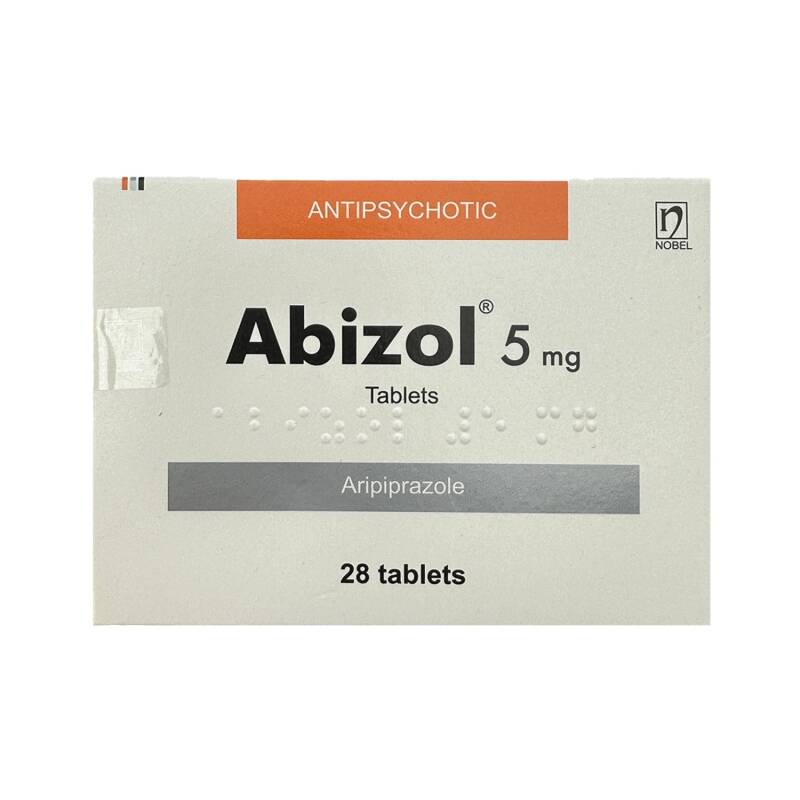
Active substance: Each tablet contains 5 mg, 10 mg, or 15 mg aripiprazole. Excipients: mannitol, crospovidone (Poliplasdon XL 10), crospovidone (Kollidon CL-F), povidone (PVP K-30), magnesium stearate, FD&C Blue 2 (indigocarmine lake) (E132) (Abizol® 5 mg), red iron oxide (E172) (Abizol® 10 mg), yellow iron oxide (E172) (Abizol® 15 mg).
Indications for use :
Abizol® is prescribed for the treatment of schizophrenia in adults and in adolescents aged 15 years and older. Abizol® is also prescribed for the treatment of moderate to severe manic episodes in patients with bipolar disorder type I, and for the prevention of new episodes in patients who have previously experienced manic episodes and have responded to treatment with aripiprazole. Abizol® is prescribed for the treatment of moderate to severe manic episodes for up to 12 weeks in adolescents aged 13 years and older with bipolar disorder type I.
Contraindications:
It is contraindicated in patients with hypersensitivity to aripiprazole, the active substance, or to any of the excipients contained in the tablet.
Use during pregnancy and lactation:
No appropriate clinical studies have been conducted with aripiprazole in pregnant women. Although congenital anomalies have been reported, it is not known whether this is due to aripiprazole intake. Animal studies do not exclude the potential for toxicity to development. Patients should inform their doctor if they are planning to become pregnant or if they intend to become pregnant during treatment with aripiprazole. In any case, because information on safety for humans is limited and because the results of animal studies raise concerns, aripiprazole should be used in pregnant women only when the benefit to the mother outweighs the risk to the fetus. Infants exposed to the effects of antipsychotic medicines (including aripiprazole) during the 3rd trimester of pregnancy may experience additional side effects such as extrapyramidal and/or “withdrawal” symptoms, with severity varying after birth in terms of weight and duration. It has been noted that such infants may experience agitation, hypotonia, hypertension, tremor, drowsiness, respiratory disorders, and feeding disorders. Therefore, such infants should be kept under careful monitoring. Aripiprazole is excreted into breast milk. A decision should be made whether to discontinue aripiprazole treatment and/or discontinue breastfeeding, taking into account the benefit of aripiprazole treatment for the mother and the benefit of breastfeeding for the child.
Adults For schizophrenia: the recommended starting dose is 10 or 15 mg/day, then maintaining a dose of 15 mg/day, once daily, regardless of food intake. Abizol® is effective in the dose range of 10–30 mg/day. Although there is no evidence that efficacy increases at daily doses higher than 15 mg, some patients may be effective at higher doses. The maximum daily dose must not exceed 30 mg. For bipolar disorder type I: manic episodes are 15 mg once daily, regardless of food intake, during monotherapy or combined treatment. For some patients, a higher dose may be effective. The maximum daily dose must not exceed 30 mg. To prevent recurrence of manic episodes in bipolar disorder type I, in patients who have received aripiprazole for monotherapy or combined treatment of a manic episode, the treatment is continued at the same dose to prevent recurrence. Dose adjustments and/or dose reductions are made based on clinical indications. Children and adolescents For schizophrenia in adolescents aged 15 years and older: the recommended dose for Abizol® is 10 mg/day, once daily, regardless of food intake. Treatment should be started for 2 days at a dose of 2 mg/day, then increased to 5 mg/day for the next 2 days, and the recommended daily dose of 10 mg/day should be reached. If necessary, subsequent dose increases may be carried out in steps of 5 mg, provided that the daily dose does not exceed 30 mg. Abizol® is effective in the dose range of 10–30 mg/day. Although there is no evidence that efficacy increases at daily doses higher than 10 mg in adolescents, some patients may be effective at higher doses. Use of Abizol® in patients with schizophrenia under 15 years of age is not recommended due to limited data on efficacy and safety. For manic episodes in bipolar disorder type I in adolescents aged 13 years and older: the recommended dose for Abizol® is 10 mg/day, once daily, regardless of food intake. Treatment should be started for 2 days at a dose of 2 mg/day, then increased to 5 mg/day for the next 2 days, and the recommended daily dose of 10 mg/day should be reached. The duration of treatment should be as short as necessary to control symptoms and should not exceed 12 weeks. No increase in efficacy has been observed at daily doses higher than 10 mg, and it has resulted in a significant increase in the frequency of additional side effects, including EPS-related events, drowsiness, fatigue, and increased body weight. Therefore, doses higher than 10 mg/day should be used only in exceptional cases under strict clinical monitoring. Because younger patients are more likely to experience additional side effects associated with aripiprazole, the use of Abizol® in patients under 13 years of age is not recommended. Irritability associated with autistic disorder The efficacy and safety of aripiprazole have not been established in children and adolescents under 18 years of age. Tic disorders related to Tourette syndrome The efficacy and safety of aripiprazole have not been established in children and adolescents aged 6–18 years. Special patient groups Hepatic impairment No dose adjustment is required in patients with mild to moderate hepatic impairment. Data on the effects in patients with severe hepatic impairment are limited. In such patients, dosing should be carried out with caution, and the maximum daily dose of 30 mg/day should be prescribed with great caution. Renal impairment No dose adjustment is required in patients with renal impairment. Elderly patients The efficacy of aripiprazole has not been established in patients with schizophrenia and bipolar disorder aged ≥ 65 years. Considering the higher sensitivity of this population and if clinical factors warrant it, a lower starting dose should be prescribed. Gender There is no need for dose adjustment depending on gender in women and men. Smokers Based on aripiprazole metabolic pathways, no dose adjustment is required in smokers. Dose adjustment related to interactions When aripiprazole is prescribed together with strong CYP3A4 or CYP2D6 inhibitors, the dose should be reduced. After discontinuation of CYP3A4 and/or CYP2D6 inhibitors, the aripiprazole dose should be increased. When aripiprazole is prescribed together with strong CYP3A4 inducers, the dose should be increased. After discontinuation of CYP3A4 inducers, the aripiprazole dose should be reduced to the required dose..
Product Filters | ||
|---|---|---|
| Supplier Product Code | : | 111-19514 |
 Powered by
T-SOFT
E-Commerce
Powered by
T-SOFT
E-Commerce