English
Azərbaycan
Русский
49 ₼-dən pulsuz çatdırılma
Sifarişimi izlə
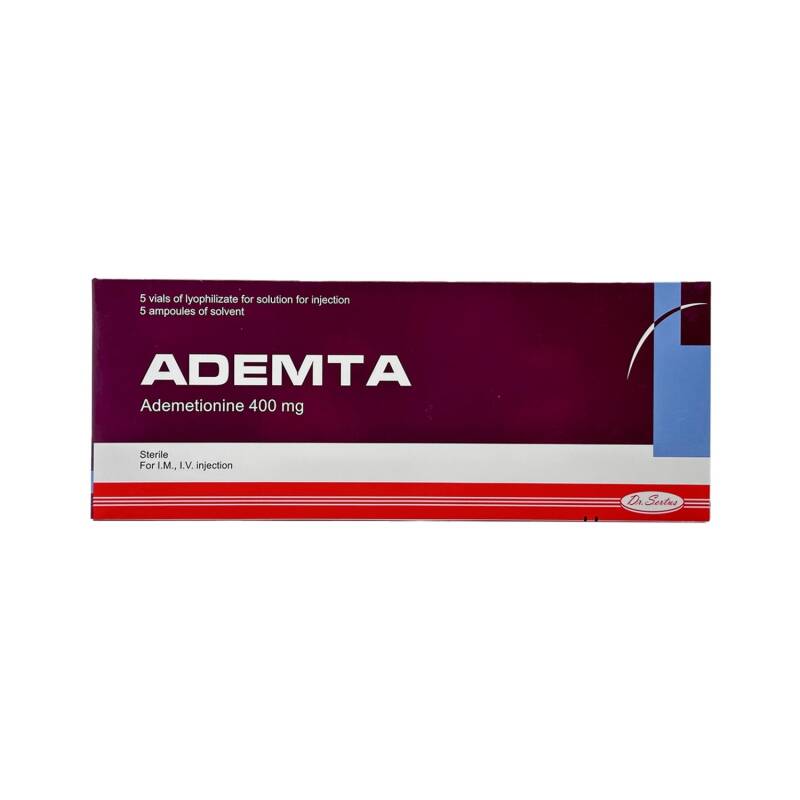
Active substance: 400 mg ademetion in 1 vial (as ademetion 1,4-butanedisulfonate). Other ingredients: mannitol: L-lysine monohydrochloride, sodium hydroxide, water for injection.
In cirrhosis and pre-cirrhotic conditions of the liver, including intrahepatic cholestasis that may be observed in the following diseases: fatty degeneration of the liver; chronic hepatitis; toxic liver injuries of various etiologies, including alcohol, viral, and drug-induced damage (including antibiotics, anti-tuberculosis and antiviral preparations, tricyclic antidepressants, oral contraceptives); chronic acalculous cholecystitis; cholangitis; liver cirrhosis; secondary encephalopathy associated with deficiency of B vitamins (including alcohol, etc.)—intrahepatic cholestatic syndrome.
High sensitivity to ademetion and/or to other components of the product; genetic disorders affecting the methionine cycle and/or disorders that cause homocystinuria and/or hyperhomocysteinemia (deficiency of cystathionine beta-synthase, disorders of vitamin B6 metabolism).
The use of ademetion in therapeutic doses during the III trimester of pregnancy has not been associated with any additional adverse effects. In the I and II trimesters, it should be used only when there is a very important need. During breastfeeding, ademetion is used only if the potential benefit of therapy for the mother outweighs the potential risk for the baby. Use of Ademetion up to 18 years of age
The effectiveness and safety have not been established.
Because dizziness may occur during treatment, it is not recommended to drive vehicles or operate other machinery until all symptoms that could affect reaction speed in the specified activities have completely disappeared.
The powder for injection is administered by intramuscular or intravenous infusion. Immediately before administration, the powder should be dissolved in a special diluent. The remaining stabilizing part must be utilized within 24 hours in a special additional vial. The solution should be prepared by dissolving in the solvent. The solution should be kept at a temperature below 25°C for no more than 6 hours and at 2°C–8°C for no more than the specified time. It is not allowed to mix the preparation with alkaline solutions and calcium ion-containing solutions. It is recommended to use the product if the color of the powder is white or with a yellowish tint; if the powder color differs from the white color (for example, due to a crack in the vial and the effect of heat), the product should not be used. Duration of treatment is determined individually by the physician. During use, the therapy should be administered very slowly: the recommended dose for intravenous or intramuscular administration is 5–12 mg/kg per day.
Intrahepatic cholestasis: administer in a dose range of 400 mg/day to 800 mg/day for 2 weeks (1–2 vials per day). Cholestatic syndrome: in initial therapy, the recommended dose is 400–800 mg/day (1–2 vials per day) for 15–20 days. If further recommended therapy is needed, continue treatment in tablet form at a dose of 800–1600 mg/day for 2–4 weeks.
Pharmacodynamics Ademetion belongs to the group of hepatoprotectors; it also has antidepressant activity and produces a choleretic effect. It has detoxifying, regenerating, antioxidant, anti-fibrotic, and neuroprotective properties. It restores the deficiency of 1-methionine (ademetion) and stimulates its excretion by the body. In metabolic processes throughout the body, higher concentrations are observed in the liver and brain, where it plays a leading role. It participates in important biochemical reactions: transmethylation, transsulfuration. It increases the amount of glutamine and increases the levels of cysteine and taurine in blood plasma; it reduces the amount of methionine in blood serum. It normalizes metabolic reactions in the liver. It has an effect on hepatocytes by normalizing the synthesis of endogenous phosphatidylcholine, which increases membrane fluidity and polarization. It improves the function of the transport system of bile acids associated with hepatocyte membranes and promotes the passage of bile acids into the excretory system, reducing the toxicity of bile acids in hepatocytes. By carrying out their conjugation and sulfation, it increases the solubility of bile acids and their elimination from hepatocytes. The sulfation process of bile acids makes their elimination by the kidneys possible, facilitates their passage through the hepatocyte membrane and excretion with bile. Additionally sulfated bile acids protect liver cells from the toxic effects of non-sulfated bile acids (which are present in high concentrations in hepatocytes during intrahepatic cholestasis). In patients with diffuse diseases (cirrhosis, hepatitis) and intrahepatic cholestasis syndrome, ademetion has been shown to reduce skin itching and changes in biochemical parameters, including the level of direct bilirubin and alkaline phosphatase activity, as well as the hepatoprotective effect. Its effectiveness has been demonstrated in hepatopathies caused by hepatotoxic drugs after discontinuation of treatment for up to 3 months. In patients with opioid drug addiction accompanied by liver damage, it has been shown to lead to regression of clinical signs of abstinence, improvement of the functional state of the liver and microsomal oxidation processes. Activity develops gradually starting from the end of the first week of treatment. It is effective in resistant recurrent endogenous and neurotic depressions during the 2 weeks of treatment. When prescribed, it reduces the severity of pain syndrome, increases proteoglycan synthesis, and leads to partial regeneration of cartilage tissue.
Absorption after parenteral administration—96%.
Maximum plasma concentration (Cmax) is reached 45 minutes after administration. It binds slightly to plasma proteins (less than 5%). A marked increase in concentration is observed in cerebrospinal fluid after crossing the hematoencephalic barrier. Biotransformation in the liver, formation, breakdown, and re-formation of ademetion is called the ademetion cycle. In the first stage of this cycle, ademetion-dependent methyltransferases use ademetion as a substrate for the production of S-adenosylhomocysteine. This is then hydrolyzed via S-adenosylhomocysteine hydrolase to homocysteine and adenosine. In turn, homocysteine can undergo reverse transformation to methionine via transfer of the methionine group from 5-methyltetrahydrofolate. Methionine can be converted back to ademetion, completing the cycle. Elimination occurs with a half-life (T½) of 1.5 hours.
Considering the activating effect of the product, it is recommended to use it before bedtime. In patients with cirrhosis, against the background of hyperammonemia, systematic monitoring of residual nitrogen is required. During therapy, it is necessary to determine the amount of urea and creatinine in blood serum. It is not recommended to prescribe it to patients with bipolar disorders. There are reports that in patients receiving antidepressants, depression may switch to hypomania or mania. There are also reports of sudden onset or worsening of anxiety in patients receiving ademetion. In such cases, discontinuation of therapy is not required. In some cases, anxiety resolves after reducing the dose or stopping the product. In patients with a high risk of suicidal thoughts and other serious adverse events, such patients should be under continuous psychiatric supervision during treatment with the product.
In patients at risk of vitamin B12 and folic acid deficiency (patients with anemia, liver diseases, during pregnancy, or with a possible vitamin deficiency due to other diseases or diet—for example, in vegetarians), ademetion may reduce the level of these vitamins; therefore, monitoring of vitamin levels is necessary. If deficiency is detected, simultaneous intake of vitamin B12 and folic acid is recommended. The results of immunological analysis of homocysteine may be affected, which can lead to a false elevation of homocysteine levels in plasma. For patients receiving the product, it is recommended to use a non-immunological method to determine homocysteine levels. Studies on the use of ademetion in patients with deficiency have not been conducted; therefore, this category of patients should be prescribed the product with caution, starting from the lower end of the dose range.
No known interactions with other medicinal products have been observed. Ademetion should be prescribed with caution together with medicinal products containing selective reuptake inhibitors, tricyclic antidepressants (such as clomipramine), as well as phytopreparations and
The following parameters have been determined in this way for the adverse reactions observed during use: frequent (≥ 1/100 to < 1/10); occasional (≥ 1/1000 to < 1/100); rare (≥ 1/10000 to < 1/1000).
Infections and infestations: occasional—urinary tract infections.
Immune system: occasional—hypersensitivity reactions, anaphylactoid or anaphylactic reactions (including hyperemia of the skin, shortness of breath, bronchospasm, back pain, discomfort in the chest area, changes in arterial pressure (arterial hypotension, arterial hypertension) or changes in pulse rate (tachycardia, bradycardia)).
Psychiatric disorders: frequent—agitation, insomnia; occasional—anxiety, confusion.
Nervous system: frequent—headache; occasional—dizziness, paresthesia.
Cardiovascular system: occasional—palpitations, phlebitis, arterial hypotension.
Chest, mediastinum and thoracic organs: occasional—throat edema.
Gastrointestinal disorders: frequent—abdominal pain, diarrhea, nausea; occasional—dry mouth, dyspepsia, flatulence, abdominal pain, gastrointestinal bleeding, gastrointestinal disorders, vomiting; rare—abdominal bloating, esophagitis (including rash, skin itching, erythema).
Skin and subcutaneous tissue: frequent—itching; occasional—increased sweating, angioneurotic edema, skin allergic reactions.
Musculoskeletal system and connective tissue: occasional—arthralgia, muscle spasms with skin necrosis at the injection site; rare—general malaise disorders and changes at the injection site: occasional—asthenia, edema, fever, chills, reactions at the injection site.
Product Filters | ||
|---|---|---|
| Supplier Product Code | : | 111-23556 |
 Powered by
T-SOFT
E-Commerce
Powered by
T-SOFT
E-Commerce