English
Azərbaycan
Русский
49 ₼-dən pulsuz çatdırılma
Sifarişimi izlə
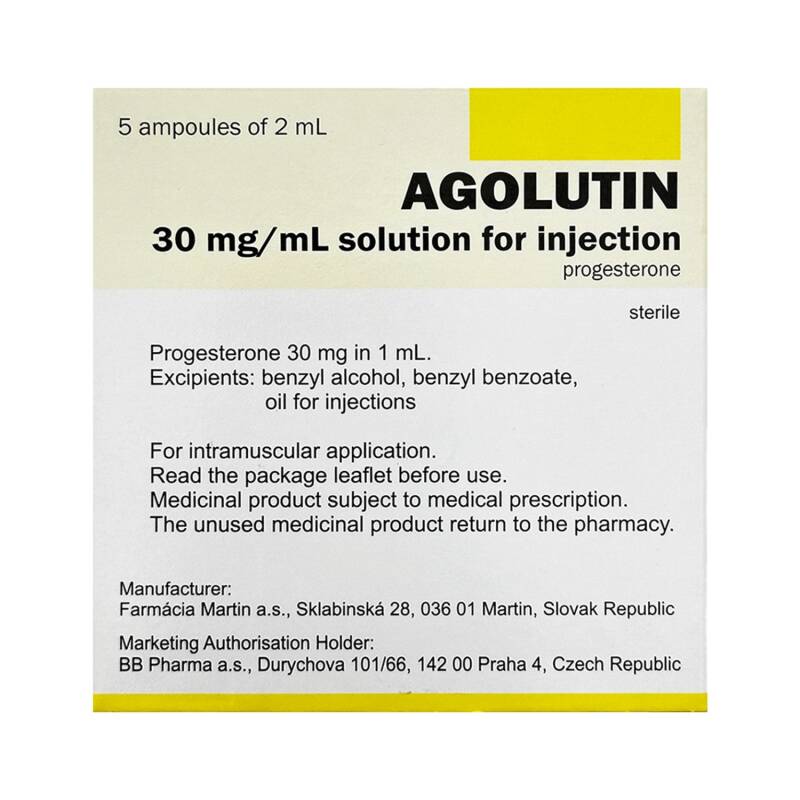
In 1 ml of solution there is 30 mg progesterone. Excipients: benzyl alcohol, benzyl benzoate, sunflower oil. and/or increased sensitivity to any of the excipients. Do not use: uterine bleeding of organic cause without excluding it; dysfunctional uterine bleeding due to not administering estrogens at the same time; with thrombophlebitis; in thromboembolic disease; in a history of pulmonary embolism; in acute and chronic liver diseases; during lactation. 620-PI.1-V.03-Az
Insufficiency of progesterone synthesis in the corpus luteum of the ovary (no secretory transformation of the endometrium). In hypofunctional disorders of the menstrual cycle or in dysfunctional uterine bleeding, in cases of recurrent miscarriage due to insufficient progesterone synthesis, to maintain pregnancy. For prevention of premenstrual syndrome and postpartum depression. As a means of inducing bleeding in cases of insufficiency of progesterone synthesis in the corpus luteum of the ovary (anovulation), it is used for a progesterone test to ensure rapid shedding of the endometrium.
“Suspicious” abortion is not suspected unless a “suspected” abortion is not suspected; pregnancy can be maintained with natural or “pure” synthetic gestagens (without any androgen and estrogen, as usual
high dose leading to drowsiness or uterine spasm can occur when the concentration reaches only 1/10
No specific test was performed to prove a decrease in concentration; the likelihood of an effect at the given dose was low; after very high doses, the hypnotic effect is described as dose-dependent
The preparation is used intramuscularly for replacement of progesterone in cases of amenorrhea only when there is evidence of sufficient estrogen synthesis in the ovaries, i.e., if the progesterone test is positive. In oligomenorrhea, to avoid dysfunctional bleeding episodes, every 42nd cycle—if spontaneous menstruation does not occur—60 mg AQOLUTİN is injected intramuscularly. After repeating the application of these AQOLUTİNs, if there is no bleeding, it is considered that the decrease in estrogen synthesis in the ovaries is stable and that, during recurrent miscarriages, treatment with progesterone is carried out only when there is evidence of progesterone synthesis deficiency. 25–100 mg AQOLUTİN is used 2 times per week (or every day if necessary) up to the 8th–16th week of pregnancy (or longer), depending on the results of direct or indirect monitoring of progesterone levels in the body. For the test, 60 mg AQOLUTİN is prescribed; if pregnancy does not occur within 14 days, the test is negative.
This (outside pregnancy) is justified only in cases where the endometrium is not prepared properly or where there is an organic disorder of the uterus; prophylactic use is confirmed only when there is evidence of progesterone synthesis deficiency (during pregnancy, after therapy for anovulatory infertility using luteal insufficiency, clomiphene, and similar agents). In these cases, monitoring of progesterone levels should be performed.
Pharmacodynamics: In clinical practice, many of the evidence demonstrating the use of natural progesterone as a substitute for deficient progesterone show that, after the use of many dosage forms of hormonal preparations for more than 10 years, the results of empirical clinical studies are available. In a double-blind, randomized, placebo-controlled study after progesterone to demonstrate premenstrual tension, significant improvements compared with placebo are known. An intramuscular injection of 30 mg progesterone produces a plasma level of 20–40 nmol/1–1 in the luteal phase. Doses higher than 50 mg produced results close to the levels observed during pregnancy. The half-life is very short: the distribution phase was from 3 to 6 minutes; the volume varied between 17 and 19 1. Progesterone, absorbed by fat that releases it gradually, binds to plasma albumin; as a result, it binds to corticosteroid-binding globulin at 95%–96%. The concentration in the brain fluid reaches 10% of the plasma level. The substance passes through the placental barrier into breast milk.
Biotransformation: Especially in the liver—about 65%—as well as in the kidneys, brain, uterus, and skin, it undergoes biotransformation. It is excreted in urine in the form of pregnanediol glucuronide with significant enterohepatic circulation; about 10% is excreted in feces. The phase lasts from 19 to 95 minutes.
Clinically significant interactions are not known. Preparations such as phenobarbital, phenytoin, rifampicin, primidone, and carbamazepine reduce the effect of progesterone and increase its plasma level; they inhibit its metabolism. If women with endometriosis take synthetic progestagens, for example norethisterone, during the use of progesterone there may be potentially beneficial interactions. These are associated with incorrect negative results related to the absorption of radioactive iodine by proteins and the thyroid gland, or with a decrease in values for iodine determination.
(without) it was not a contraindication; when prescribed only in cases of proven deficiency of progesterone secretion, it threatens virilization of the fetus and helps prevent recurrent miscarriages, and increases the number of cases of ectopic pregnancy. AQOLUTİN should not be used while breastfeeding: nausea, vomiting, occasional hyperpyrexia, changes in body weight, edema; CNS: neurosis, seizures, changes in libido, drowsiness, tendency to depression, in rare cases headache or chloasma, breast tenderness, malaise, vulvar itching, candidiasis, and local irritation.
Product Filters | ||
|---|---|---|
| Supplier Product Code | : | 111-07932 |
 Powered by
T-SOFT
E-Commerce
Powered by
T-SOFT
E-Commerce