English
Azərbaycan
Русский
49 ₼-dən pulsuz çatdırılma
Sifarişimi izlə
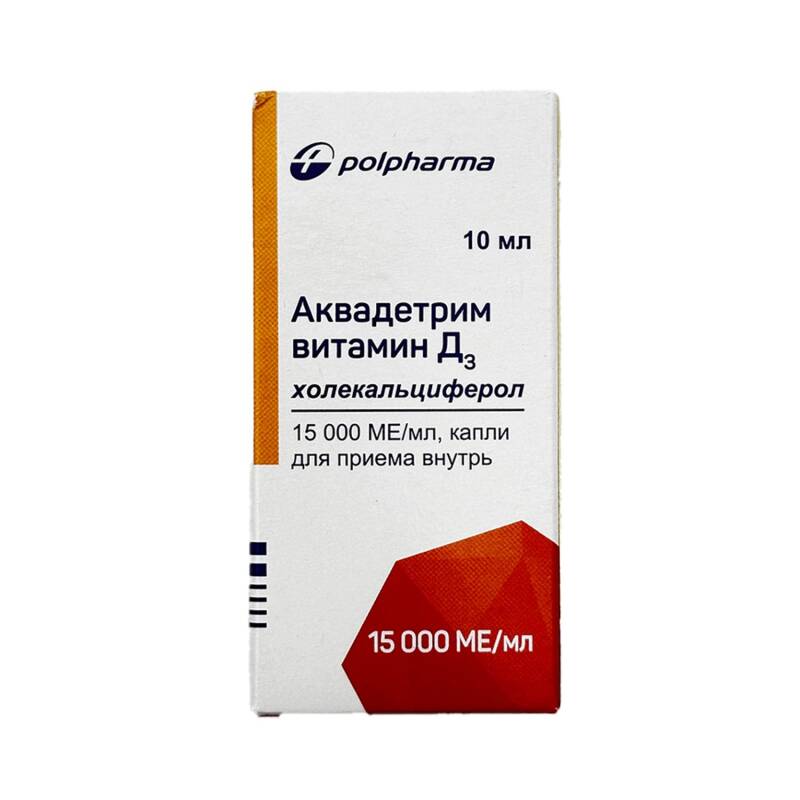
In 1 ml of solution (30 drops) there is 15,000 IU of cholecalciferol. Ingredients: medium-chain triglycerides. The solution is transparent, colorless to light yellow. contraindications: hypersensitivity to any of the active or excipient ingredients and/or hypercalciuria and/or nephrocalcinosis. Clearly expressed impairment of renal function. • Sarcoidosis. D vitamin hypervitaminosis.
Pseudohypoparathyroidism. In disease periods accompanied by normal sensitivity to vitamin D, the body’s need for vitamin D may decrease, therefore there is a risk of long-term overdose. For treatment of this condition, there are derivatives whose effect can be controlled better than vitamin D.
In children and adults: prevention of rickets and osteomalacia; in prematurely born newborns: prevention of rickets; in adults in the risk group: prevention of vitamin D deficiency; in adults with malabsorption syndrome: prevention of vitamin D deficiency; in adults: treatment of rickets and osteomalacia; supportive treatment in osteoporosis; treatment of hypoparathyroidism.
Before starting to use the product, it is necessary to consult a doctor
If increased requirement for vitamin D in a female patient has been diagnosed, vitamin D preparations must be taken under medical supervision, as excess vitamin D may be harmful to the child.
Does not affect ability.
Akvadetrim vitamin D preparation should be taken in accordance with the doctor’s recommendations; if necessary, consult a doctor. The regimen depends on the nature and severity of the disease; the treating physician determines it individually for each specific case. During long-term intake of vitamin D in doses higher than 1,000 IU per day, it is necessary to monitor the concentration of calcium in the serum (see: “Special instructions”). For prevention of rickets and osteomalacia in children and adults: 1 drop every day (equivalent to 500 IU of vitamin D).
In prematurely born newborns: 2 drops every day (equivalent to 1,000 IU of vitamin D) until a corrected post-conceptual age of 40 weeks is reached. After that, the prophylactic dose of vitamin D should be reduced; the regimen is determined individually by the treating physician. For prevention of vitamin D deficiency in adults in the risk group: 1 drop every day (equivalent to 500 IU of vitamin D). In children and adults with malabsorption syndrome: prevention of vitamin D3 deficiency.
6–10 drops every day (3,000–5,000 IU of vitamin D). For treatment of rickets: In newborns, children in their first year of life, and young children (from 0 to 5 years): 2–4 drops every day (equivalent to 1,000–2,000 IU of vitamin D). In children over 5 years and adults: 4–10 drops every day (equivalent to 2,000–5,000 IU of vitamin D). For treatment of osteomalacia: In adults: 2–10 drops every day (equivalent to 1,000–5,000 IU of vitamin D). Supportive treatment during osteoporosis: 2 drops every day (equivalent to 1,000 IU of vitamin D).
For treatment of hypoparathyroidism: the recommended dose range in adults depends on the level of calcium in the serum; vitamin D is administered in the range of 10,000 to 200,000 IU per day. If the daily dose of vitamin D in patients is 10,000 IU (up to 20,000 IU), then it is necessary to determine the calcium level in the serum every 3–6 months. At the beginning, every 4–6 hours. Duration of treatment. For prevention of rickets and osteomalacia: Akvadetrim vitamin D is prescribed to newborns and children in their first year of life starting from the 2nd week of life until the completion of 1 year. It is recommended to continue the use of the vitamin D preparation in the second year of the child’s life, especially during the winter months of the year. For treatment of osteomalacia: the duration of treatment should be 6 weeks, after which prophylactic doses should be prescribed. To measure the dose of the preparation accurately, when counting the drops, keep the bottle at a 45° angle. It should be taken with a spoon of liquid.
Pharmacodynamics The biologically active form of vitamin D stimulates the absorption of calcium in the intestine, the incorporation of calcium into the osteoid, and the release of calcium from bone tissue. Under the action of vitamin D, the passive and active transport of phosphorus is strengthened. It stimulates in the kidneys the tubular reabsorption of calcium and phosphorus, thereby slowing their excretion from the body. Production of parathyroid hormone (PTH) in the parathyroid glands is directly inhibited by the biologically active form of vitamin D. Secretion is also inhibited as a result of increased retention of calcium in the small intestine under the influence of the biologically active form of vitamin D. Absorption Vitamin D is well absorbed in the gastrointestinal tract with the participation of bile; therefore, taking the preparation together with the main food intake may lead to more complete absorption of vitamin D and affect its metabolism. In the liver, vitamin D is hydroxylated to 25-hydroxycholecalciferol and subsequently in the kidneys it undergoes hydroxylation to the active metabolite 1,25-dihydroxycholecalciferol (calcitriol). Metabolites circulating in the blood bind to a specific α-globulin. Vitamin D and its metabolites are excreted mainly in bile and feces.
Pharmacokinetics in individual patient populations It is necessary to take into account the possible risk of calcification of soft tissues; it should be prescribed with caution to patients treated for their diseases (see: “
Vitamin D should be prescribed with caution to patients with sarcoidosis, because in such patients it is possible to increase the intensity of vitamin D metabolism to its active form. When used in such patients, it is necessary to monitor the level of calcium in serum and urine. When determining the total daily dose of vitamin D, it is necessary to take into account the intake of other medicinal products containing vitamin D, the use of food products enriched with vitamin D (including milk), and the patient’s exposure to sunlight. There are no facts proving a direct cause-and-effect relationship between vitamin D intake and the formation of calculi in the kidneys; however, the existence of such risk is completely possible, especially when additional calcium intake is carried out. The need for additional intake must be determined individually for each patient; additional intake should be accompanied by strict medical supervision. During long-term intake of vitamin D in doses higher than 1,000 IU per day, it is necessary to monitor the concentration of calcium in the serum and also monitor kidney function by determining the level of creatinine in the serum.
Such monitoring is of particular importance in elderly patients treated concomitantly with cardiac glycosides and/or diuretics (see: “ ”), as well as in patients with a high risk of calculi formation, when (300 mg (7.5 mmol)/24 hours) or signs of impaired renal function appear—then it is necessary to reduce the dose or discontinue treatment. Information has been reported that oral use of high doses of vitamin D (once a year 500,000 IU) in elderly patients, especially within the first 3 months after taking the preparation, may be accompanied by an increased risk of bone fractures (even if the warnings relate to cases that occurred in the past). It is necessary to inform the doctor about all medicinal products taken recently, including over-the-counter drugs. Concomitant use of anti-seizure preparations (e.g., phenytoin) or barbiturates (and other medicinal products that induce the activity of liver enzymes) may reduce the effectiveness of vitamin D due to metabolic inactivation. During concomitant treatment with thiazide diuretics, it is recommended to monitor the calcium level in serum, as they reduce excretion through the kidneys. Concomitant treatment with preparations containing cardiac glycosides or other cardiac glycosides may reduce the effectiveness of vitamin D and may increase the risk of toxicity of cardiac glycosides (development of arrhythmia). Regular determination of the calcium level is required and, if necessary, strict medical supervision together with ECG monitoring should be carried out. Concomitant use of ion-exchange resins such as colestipol hydrochloride, orlistat, or laxatives such as liquid paraffin may reduce and/or decrease the absorption of vitamin D in the gastrointestinal tract. Concomitant treatment with isoniazid may reduce the effectiveness of vitamin D. Vitamin D may reduce the effectiveness of medicinal products prescribed for hypercalcemia, such as calcitonin, etidronate, and pamidronate.
Concomitant intake of vitamin D with antacids containing magnesium may cause hypermagnesemia. Concomitant intake of vitamin D with antacids containing aluminum may lead to an increase in aluminum levels, which is associated with an increased risk of bone toxicity. The simultaneous use of several analogues of vitamin D
When using Akvadetrim vitamin D, the following warnings should be considered: vitamin D should be used with caution in patients with impaired renal function. In this case, it is necessary to monitor the levels of calcium and phosphorus in the blood; consult a doctor.
Like any medicinal product, Akvadetrim may cause side effects, although not everyone experiences them: decreased appetite, decreased body weight, excessive thirst, mood decrease (depression), psychotic disorders, decreased libido, headache, drowsiness, disturbance of heart rhythm, increased arterial blood pressure, cough, fever, increased amount of calcium in blood, urine and tissues, increased amount of uric acid and creatinine in blood (uremia) • formation of stones in the kidneys (nephrolithiasis), increased frequency of urination, pain in muscles and joints, muscle weakness, increased results of liver function tests, skin rash, hives, itching, increased sweating, increased sensitivity to light, inflammation of the eyes, inflammation of the pancreas, increased cholesterol level in the blood, dry mouth, nausea, vomiting, constipation, flatulence, abdominal pain or diarrhea. During treatment with Akvadetrim vitamin D, other side effects may occur in patients. If any of the listed side effects occur, or if any other side effect not mentioned in this leaflet occurs, you should inform your doctor. During maintenance of functions that may be included in the prescription, calcium levels can be reliably reduced by infusion of an isotonic sodium chloride solution (3–6 liters within 24 hours) with the addition of furosemide and, in some cases, sodium edetate at 15 mg/kg body weight per hour. This should be accompanied by continuous monitoring of calcium levels in the blood and ECG monitoring. In anuria, hemodialysis is required (using a dialysis solution without calcium). There is no specific antidote. In patients receiving long-term treatment with high doses of vitamin D, it is recommended to actively detect intoxication symptoms (nausea, vomiting, diarrhea in the initial stages, constipation in later stages, decreased appetite, fatigue, headache, muscle pain, joint pain, muscle weakness, persistent drowsiness, azotemia, polydipsia, polyuria).
Product Filters | ||
|---|---|---|
| Supplier Product Code | : | 111-00402 |
 Powered by
T-SOFT
E-Commerce
Powered by
T-SOFT
E-Commerce