English
Azərbaycan
Русский
49 ₼-dən pulsuz çatdırılma
Sifarişimi izlə
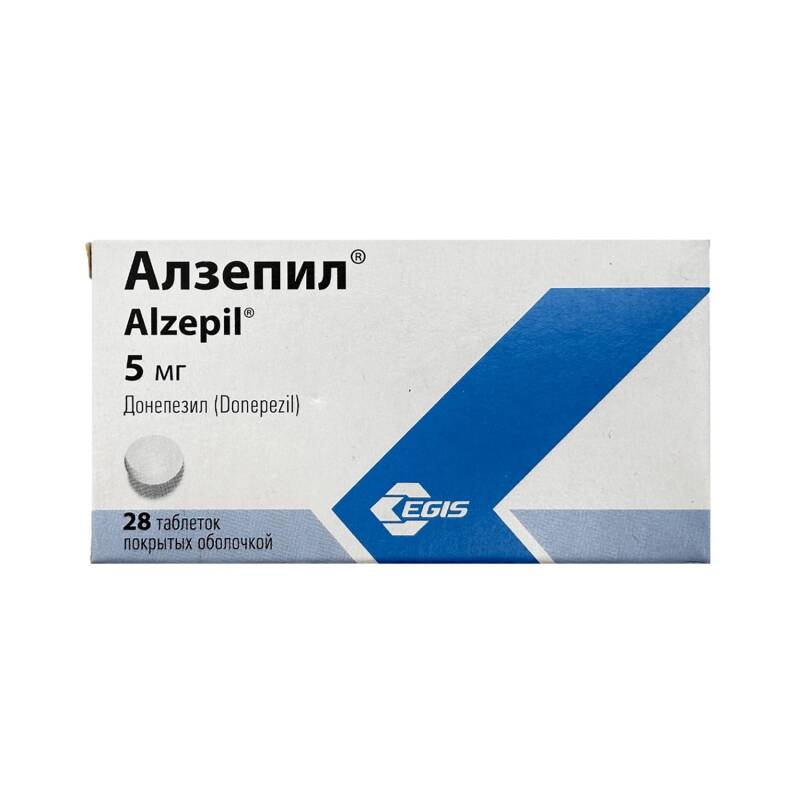
The active ingredient in 1 tablet is 5 mg (as 5.21 mg donepezil hydrochloride monohydrate) and/or 10 mg (as 10.42 mg donepezil hydrochloride monohydrate) donepezil hydrochloride. Excipients: microcrystalline cellulose, low-substituted hydroxypropylcellulose (L-HPC B1), magnesium stearate: white opadry Y-1-7000 (hypromellose, titanium dioxide (E 171), macrogol 400.
Alzepil is indicated for symptomatic treatment of mild to moderate Alzheimer’s disease.
Alzepil is contraindicated in patients with hypersensitivity to piperidine derivatives or to any component of the product in their medical history.
No data is available. In animal studies, no teratogenic effects of donepezil were observed; however, signs of peri- and postnatal toxicity were noted. The potential risk to humans is unknown. Alzepil should not be used unless absolutely necessary. In rats, donepezil is excreted in breast milk. Whether donepezil passes into human breast milk has not been determined; no studies have been conducted involving pregnant women. Therefore, women using donepezil should not breastfeed their infants.
Donepezil has an insignificant or mild effect on the ability to drive and operate machinery. However, it may worsen the ability to drive or work with machinery; donepezil can cause fatigue, dizziness, and muscle spasms, especially at the beginning of the course or when the dose is increased. Patients regularly taking donepezil should assess their ability to drive vehicles and operate complex machinery.
Adults and elderly patients: Treatment should be started with a dose of 5 mg once daily, taken by mouth in the evening before going to sleep. To evaluate the earliest clinical responses and to achieve steady-state concentrations of donepezil, the daily 5 mg dose should be used for at least one month. After clinically evaluating the effect of the 5 mg dose over one month, the dose of Alzepil may be increased to 10 mg once daily. The recommended maximum daily dose is 10 mg. Higher doses have not been studied. In clinical trials, it is necessary to use doses other than those listed above only if required. Treatment should be initiated and carried out under the supervision of a physician experienced in the diagnosis and treatment of Alzheimer’s dementia. It should be confirmed according to generally accepted recommendations, for example DSM-IV and ICD-10 recommendations. Treatment initiation is possible only when there are persons who can provide patient care and regularly monitor the use of the medicinal product. Treatment should be continued until a therapeutic effect is observed in the patient. Therefore, the clinical effect of donepezil should be assessed regularly. If the effect is not observed, consideration should be given to the possibility of discontinuing the medicinal product. It is not possible to predict an individual response. After discontinuation, a gradual weakening of the positive effect of Alzepil may be observed; a “rebound” effect has not been observed when use is stopped abruptly. Effect on the results of laboratory and instrumental studies: Injuries, intoxications, and worsening of complications of manipulation; adverse events and a slight increase in creatine kinase in blood serum. *When examining patients with syncope and/or seizure episodes, the possible occurrence of cardiac block or prolonged phase in sinus rhythm should be considered.
**In cases where information is provided, the development of hallucinations, abnormal dreams, frightening dreams, restlessness and aggressive behavior stopped after reducing the dose or discontinuing the medicinal product. ***In case of unexplained impairment of liver function, the possibility of discontinuing Alzepil should be considered. ****There have been reports that rhabdomyolysis may develop in a short period of time regardless of malignant neuroleptic syndrome and in connection with the initiation of treatment or an increase in the dose of donepezil. Additional information about side effects should be provided regarding the possible
Mechanism of action: Donepezil hydrochloride is a specific, reversible inhibitor of acetylcholinesterase, the main cholinesterase in the brain. In in vitro experiments, the inhibitory effect of donepezil hydrochloride on this enzyme was more than 1000 times stronger than its effect on butyrylcholinesterase, which is located outside the central nervous system.
In patients with severe Alzheimer’s dementia, other types of dementia, or memory disorders (for example, age-related weakening of cognitive functions), a study was developed to exclude patients suffering from dementia with Lewy bodies and to identify patients in whom dementia could be of vascular origin only. In the study, the incidence of deaths was 2/198 (1%) in the group receiving donepezil hydrochloride 5 mg, 5/206 (2.4%) in the group receiving donepezil hydrochloride 10 mg, and 7/199 (3.5%) in the group using placebo. In the study, the incidence of deaths was 4/208 (1.9%) in the group receiving donepezil hydrochloride 5 mg, 3/215 (14%) in the group receiving donepezil hydrochloride 10 mg, and 1/193 (0.5%) in the placebo group. In the study, the incidence of deaths was 11/648 (1.7%) in the group receiving donepezil hydrochloride 5 mg and 0/326 (0%) in the placebo group. In all three studies conducted in the direction of investigation, compared with the placebo group (1.1), the incidence of deaths was quantitatively higher in all groups using donepezil hydrochloride (1.7%), but these differences were not statistically significant. Most deaths in patients using donepezil hydrochloride or placebo occurred in the indicated population of elderly patients in whom various presumed vascular disorders were present as a result of vascular damage. In the analysis of all serious vascular disorders that did not cause death and resulted in death, no differences were found in the incidence rates between the groups using donepezil hydrochloride and placebo. In the generalized materials of Alzheimer’s disease studies (total number of patients 6888), including studies of the disease (n=4146) and additional studies of vascular dementia, it was shown that in the placebo group the death indicators were quantitatively higher than the same indicators recorded in the groups using donepezil hydrochloride. There is no requirement.
Any unused quantity and residue of the medicinal product should be disposed of according to the relevant local requirements.
In the human body, donepezil hydrochloride and/or any of its metabolites do not show an inhibitory effect on the metabolism of theophylline, warfarin, cimetidine, or digoxin, and when used simultaneously with cimetidine, the metabolism of donepezil does not change. This has been shown in in vitro studies. In in vitro studies investigating interactions with other medicinal products, it has been shown that the metabolism of donepezil involves the cytochrome P450 system isoenzyme 3A4 and, to a lesser extent, isoenzyme 2D6. In in vitro studies, inhibitors of CYP3A4 and 2D6 isoenzymes inhibit the metabolism of donepezil, namely ketoconazole and quinidine. Therefore, the indicated medicinal products and inhibitors of the CYP3A4 isoenzyme, for example itraconazole and erythromycin, as well as inhibitors of the CYP2D6 isoenzyme, for example fluoxetine, may inhibit the metabolism of donepezil. In a study involving volunteers, ketoconazole caused an approximately 30% increase in donepezil concentrations. Although the width of the range of inhibitory and/or inducing effects of inducers such as rifampicin, phenytoin, carbamazepine, and alcohol may be non-specific, when combinations of the above medicinal products are prescribed, precautions should be followed. In addition, Alzepil may interact with medicinal products that have anticholinergic activity. It may also interact with medicinal products used simultaneously, for example succinylcholine. Anesthesia: Alzepil is an inhibitor of the cholinesterase enzyme; therefore, during anesthesia, the medicinal product may cause an enhancement of succinylcholine muscle relaxation. Based on its pharmacological effects, inhibitors of cholinesterase may show vagotonic effects on the heart rate (for example, may cause the occurrence of bradycardia).
In cases of weakness of the sinoatrial node or other disorders of supraventricular conduction in the heart, such as sinoatrial or atrioventricular block, this should be taken into account. Information has been received about syncope and/or seizure episodes associated with the use of the medicinal product. When examining patients, the possible occurrence of cardiac block or prolonged pauses from sinus rhythm should be considered. In order to detect symptoms of the formation of ulcers noted in gastrointestinal tract functions in a timely manner, patients who face an increased risk of ulcer development, for example those with a history of ulcer disease or those receiving concomitant treatment with non-steroidal anti-inflammatory medicinal products (NSAIDs), require careful monitoring. However, in clinical trials compared with placebo, no increase in the incidence of peptic ulcers or gastrointestinal bleeding associated with the use of donepezil was detected. Disorders noted in the system: Cholinomimetics may cause impaired urine flow from the urinary bladder; however, in clinical trials of donepezil, the indicated effects were not observed in neurological conditions. It is assumed that cholinomimetics may trigger the occurrence of generalized seizure episodes; seizure activity may also be a manifestation of Alzheimer’s disease. It may lead to increased severity of extrapyramidal symptoms or their occurrence, and may cause neuroleptic malignant syndrome (NMS). Very rarely, a life-threatening syndrome characterized by hyperthermia (fever), muscle rigidity, disorders of autonomic nervous system functions, altered consciousness, and increased levels of creatine phosphokinase in blood serum—NMS—may develop. There have been reports regarding the development of this syndrome, especially in patients receiving concomitant treatment with antipsychotic medicinal products. When signs and symptoms of NMS develop in a patient, or when high fever is noted with pulmonary function disorders that cannot be explained without additional clinical manifestations, treatment should be discontinued. Cholinomimetics have cholinomimetic effects; therefore, in patients with a history of asthma or obstructive diseases, Alzepil should be prescribed with caution, and it is necessary to avoid simultaneous use of cholinergic system agonists or antagonists. There are no data on the use of the medicinal product in patients with severe hepatic impairment. In clinical studies conducted to investigate vascular dementia, the death indicator was assessed in patients with possible or probable vascular dementia (VD) according to the NINDS-AIREN criteria. Three clinical trials were conducted over a period of 6 months with patients meeting these criteria. There is a possibility of synergistic effects with other biomarkers of Alzheimer’s boundary muscle conduction, as well as with antagonists of the cholinergic system or with beta-blockers that affect the heart’s conduction ability.
Incompatibility cannot be applied.
It is important to provide information about this, which allows continuous monitoring of the benefit/risk ratio of the medicinal product. Healthcare professionals should report any suspected adverse effects to the address indicated at the end of the package leaflet, as well as through the national reporting system.
Product Filters | ||
|---|---|---|
| Supplier Product Code | : | 111-15542 |
 Powered by
T-SOFT
E-Commerce
Powered by
T-SOFT
E-Commerce