English
Azərbaycan
Русский
49 ₼-dən pulsuz çatdırılma
Sifarişimi izlə
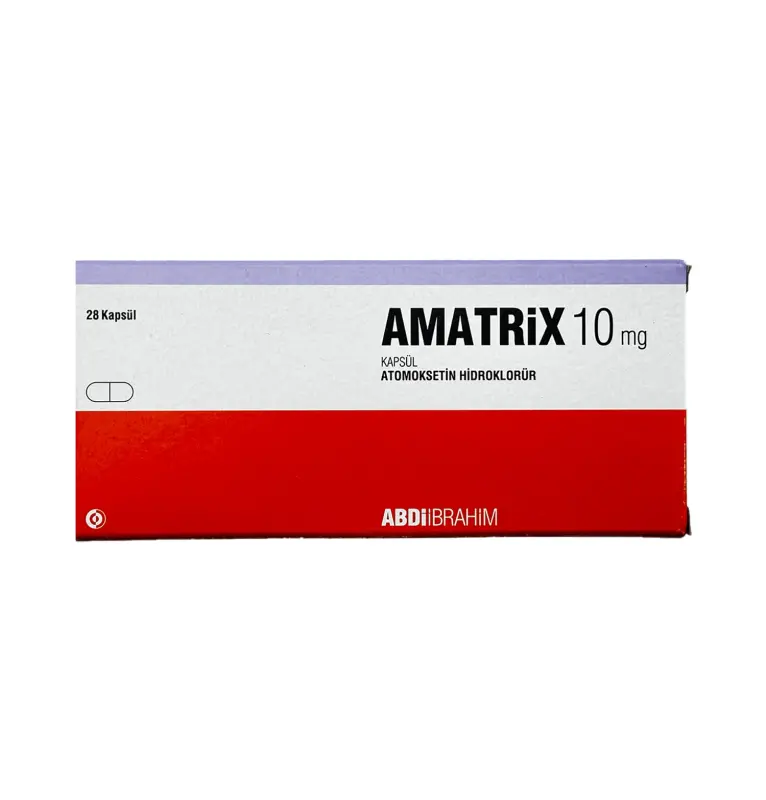
Active substance: Each capsule contains atomoxetine hydrochloride in an amount equivalent to 10 mg atomoxetine.
Hypersensitivity to the active substance or to any of the excipients (see: “Composition”).
Atomoxetine must not be used together with monoamine oxidase inhibitors (MAOIs) and/or within at least 2 weeks after discontinuation of MAOI treatment. After discontinuation of atomoxetine treatment, MAOI treatment must not be started within at least 2 weeks. In clinical studies, atomoxetine use was associated with an increased frequency of mydriasis; therefore, it should not be used in patients with angle-closure glaucoma.
Atomoxetine is contraindicated in patients with symptomatic cardiovascular disease, moderate to severe hypertension, and in patients with serious cardiovascular or cerebrovascular disorders in whom the condition may be clinically worsened by an increase in blood pressure and/or heart rate. Serious cardiovascular disorders may include: severe hypertension, heart failure, arterial occlusion, angina pectoris, hemodynamically significant congenital heart disease, cardiomyopathies, myocardial infarction, life-threatening arrhythmias and channelopathies (disorders resulting from dysfunction of ion channels). Serious cerebrovascular disorders may include cerebral aneurysm or stroke.
Serious, sometimes fatal reactions have been reported when used in combination with MAOIs, or with other medicines that affect the concentration of monoamines in the brain (including hyperthermia, rigidity, myoclonus, vegetative instability with possible rapid changes in vital functions, and changes in mental status, including extreme agitation progressing to delirium and coma). In some cases, symptoms similar to malignant neuroleptic syndrome have occurred. These reactions occur when these medicines are used together or in close succession.
Atomoxetine should not be used in patients with pheochromocytoma or with a history of pheochromocytoma.
General recommendations
Pregnancy category: C.
Women of childbearing potential / Contraception (Contraception)
When pregnancy is suspected and during pregnancy, the doctor must be informed. A suitable method of contraception should be chosen for women of childbearing potential using atomoxetine.
Pregnancy
In animal studies, there was generally no evidence of direct harmful effects on pregnancy, embryonic development/fetal development. Clinical data on the effect of atomoxetine on pregnancy are limited. These
data are not sufficient to indicate any interaction between atomoxetine and additional effects on pregnancy and/or lactation. Atomoxetine should not be used unless the potential benefit to the mother outweighs the potential risk to the fetus.
Lactation
It is not known whether atomoxetine passes into human breast milk. Animal studies do not show that atomoxetine and/or its metabolites are excreted into milk. Due to insufficient data, atomoxetine should be avoided during lactation.
Reproductive ability / Fertility
There are no data obtained from human reproduction studies. In doses up to 57 mg/kg per day, which is approximately 6 times the maximum human dose on a mg/m2 basis, atomoxetine was administered to rats, but no harmful effects on fertility were observed.
Dosage: for children and adolescents aged 6 years and older with body weight up to 70 kg, the dosage: the starting dose of AMATRIKS is approximately 0.5 mg/kg per day. The starting dose should be maintained for at least 7 days before any further upward titration based on clinical response and tolerability. The recommended maintenance dose is approximately 1.2 mg/kg per day (depending on the patient’s body weight and the current single dose of atomoxetine). Doses higher than 1.2 mg/kg per day
have not provided additional benefit. The safety of single doses higher than 1.8 mg/kg per day and total daily cumulative doses higher than 1.8 mg/kg has not been systematically evaluated. In some cases, it may be appropriate to continue treatment into adulthood.
Dosage for children and adolescents aged 6 years and older with body weight over 70 kg: treatment with AMATRIKS should be initiated with a total daily dose of 40 mg. The starting dose should be maintained for at least 7 days before titrating to higher doses based on clinical response and tolerability. The recommended daily maintenance dose is 80 mg. Doses higher than 80 mg have not provided additional benefit. The recommended total maximum daily dose is 100 mg. The safety of single doses higher than 120 mg per day and total daily cumulative
doses higher than 150 mg has not been systematically evaluated.
Adults: treatment with AMATRIK should be initiated with a total daily dose of 40 mg. The starting dose should be maintained for at least 7 days before titrating to higher doses based on clinical response and tolerability. The recommended maintenance dose is 80–100 mg. The recommended total daily dose is 100 mg. The safety of single doses higher than 120 mg per day and total daily cumulative doses higher than 150 mg has not been systematically evaluated.
Frequency and duration of use: AMATRIK can be taken in the morning as a single dose on an empty stomach or with food. Patients who take one dose of AMATRIKS per day and cannot reach the clinical response (tolerability
[e.g., nausea and/or drowsiness] or efficacy) may take their doses in evenly divided doses, twice a day in the morning and after midday at a late time or in the evening.
Directions for use
For oral use. AMATRIKS can be taken on an empty stomach or with food.
Additional information for safe use of the product
Monitoring before treatment
Before prescribing, the patient’s relevant medical history should be obtained and the patient’s cardiovascular status should be assessed initially, including blood pressure and heart rate.
Monitoring during treatment
After each dose adjustment, at least once every 6 months, blood pressure and pulse should be measured to regularly monitor the cardiovascular status and record the results. For pediatric patients, it is recommended to use a growth percentile chart.
In adults, guidance applicable to hypertension should be followed.
Discontinuation of treatment
No significant discontinuation symptoms were identified in the study program. If any serious adverse effects occur, atomoxetine treatment may be stopped abruptly; otherwise, treatment can be discontinued by gradually reducing the dose over an appropriate time interval.
Continuous treatment with AMATRIKS is not essential. For treatments lasting more than one year, especially in patients who have had a stable and satisfactory response to treatment, the need for continued therapy should be reassessed.
Additional information regarding special patient groups
Hepatic impairment
In patients with moderate hepatic impairment (Child-Pugh class B), the starting and target doses should be reduced to up to 50% of the usual dose. In patients with severe hepatic impairment (Child-Pugh class C), the starting and target doses should be reduced to up to 25% of the usual dose.
Renal impairment
In patients with end-stage renal disease, the systemic exposure to atomoxetine was higher compared with healthy subjects (approximately 65% increase), but no difference was observed when exposure was adjusted for mg/kg dose. Therefore, AMATRIKS can be used in patients with end-stage renal disease or mild renal impairment with the normal dosing regimen. Atomoxetine may increase the severity of hypertension in humans with end-stage renal disease.
Approximately 7% of individuals of the “white” race have a genotype that results in non-functional cytochrome P450 2D6 (CYP2D6) enzyme (called poor metabolizers of CYP2D6). In patients with this genotype, the effect of atomoxetine is several times higher than in patients with a functional enzyme. Therefore, poor metabolizers are at higher risk for adverse effects. For patients with the poor metabolizer genotype, a lower starting dose and slower titration during dosing should be considered.
Pediatric patients
The safety and efficacy of AMATRIKS in children under 6 years of age have not been established. Therefore, AMATRIKS should not be used in children under 6 years of age.
Elderly patients
The use of atomoxetine in patients over 65 years of age has not been systematically evaluated.
Product Filters | ||
|---|---|---|
| Supplier Product Code | : | 111-27994 |
 Powered by
T-SOFT
E-Commerce
Powered by
T-SOFT
E-Commerce