English
Azərbaycan
Русский
49 ₼-dən pulsuz çatdırılma
Sifarişimi izlə
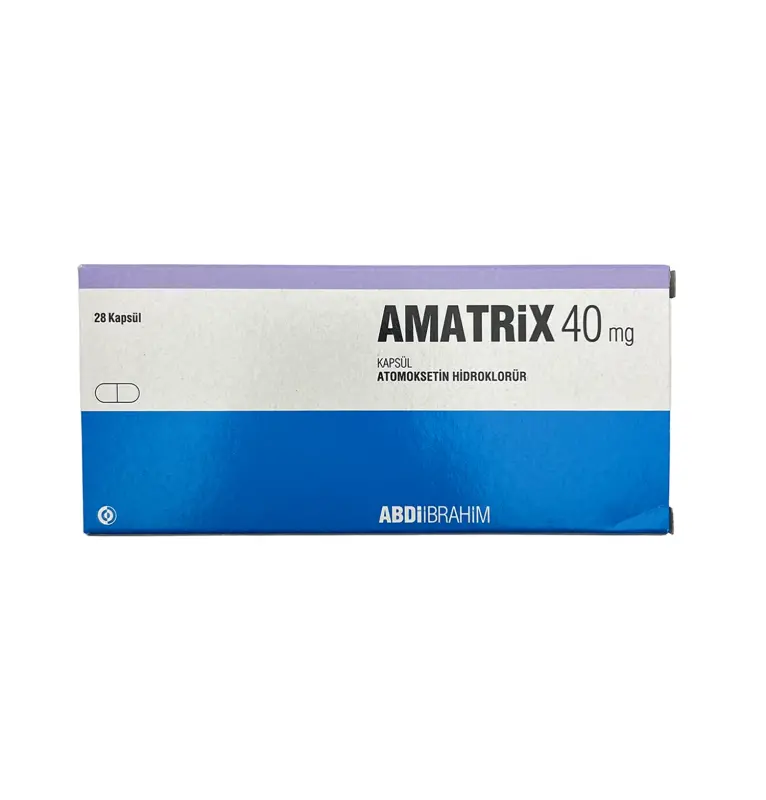
Active substance: each capsule contains atomoxetine in an amount equivalent to 40 mg. Excipients: pregelatinized starch, pregelatinized starch 1500, colloidal anhydrous silicon dioxide. Capsule shell: gelatin, titanium dioxide (E171), yellow iron oxide (E172), FD&C Blue 2 (Indigo carmine) (E132). Hypersensitivity to atomoxetine or to any of the excipients. It should not be used together with monoamine oxidase inhibitors (MAOIs) or within at least 2 weeks after discontinuation of MAOI treatment.
The Amatriks medicinal product is used for the treatment of Attention Deficit/Hyperactivity Disorder (ADHD) syndrome in children aged 6 years and older, and in adolescents and adults as part of a more complex treatment program. Treatment should be initiated by a specialist physician such as a pediatrician, child/adolescent psychiatrist, or psychiatrist, and should be determined according to the updated DSM criteria or the ICD guideline. The presence of ADHD symptoms during childhood must be confirmed. Cooperation with the patient’s social environment may be beneficial. If these symptoms are not clearly present, treatment with Amatriks should not be started. If one or more ADHD symptoms are present, diagnosis should be made based on clinical assessment in patients with moderate or more severe functional impairment, where symptoms affect the patient’s life in at least two or more settings (e.g., social, academic and/or professional). There should be at least moderate ADHD. This medicine has no antidepressant effect and is indicated only for the treatment of ADHD. For safe use of this medicinal product, additional information: A complex treatment program usually includes psychological, educational, and social measures, and aims to bring patients with a behavioral syndrome characterized by symptoms such as short-term persistence of attention, frequent distractibility, emotional lability, impulsivity, moderate-to-severe hyperactivity, insignificant neurological symptoms, and abnormal EEG to a stable condition; it is not expected that this ability will be impaired or affected.
Pharmacological treatment is not indicated for all patients with this syndrome. The decision to use the medicine should be made based on a comprehensive assessment, considering the severity of the patient’s symptoms, impairment related to the patient’s age, and the duration of symptom persistence.
(See the “ ” section.) Atomoxetine should not be used in patients with serious cardiovascular disease where there is a clinical significant increase in arterial blood pressure and the frequency of heart contractions (e.g., around 15–20 mmHg or 20 beats/min) and where worsening of the condition is likely (see the “ ” section). It should not be used in patients with cardiovascular disease. In patients with underlying conditions such as hypertension, tachycardia, or cardiovascular or cerebrovascular disease that may worsen with increased arterial blood pressure and/or heart rate, it should be used with caution. Patients who develop significant cardiac symptoms during treatment, such as palpitations, chest pain during exertion, syncope of unknown cause, shortness of breath, or other symptoms, should contact a physician immediately for assessment of the cardiological condition.
In patients with congenital or acquired long QT interval and/or Torsades de pointes, or with a family history of QT interval prolongation, atomoxetine use should be avoided (see “Diger”). It should not be used within 2 weeks after discontinuation of drug interactions (see “ ”). Atomoxetine is metabolized by CYP2D6. Therefore, in patients taking CYP2D6 inhibitors (e.g., SGUSI such as fluoxetine, paroxetine; quinidine; terbinafine), the exposure to atomoxetine may increase by 6–8 times and in patients taking CYP2D6 inhibitors, atomoxetine should be titrated more slowly and a lower final dose may be used. If a CYP2D6 inhibitor is started or treatment is stopped after atomoxetine dosing has been titrated, it should be determined whether dose adjustment is necessary based on clinical response and tolerability. Due to the unknown risk of clinically significant increases in atomoxetine exposure when using other effective cytochrome P450 enzyme inhibitors in addition to CYP2D6 inhibitors, caution is recommended when using other effective cytochrome P450 enzyme inhibitors together with atomoxetine in CYP2D6 poor metabolizers (or other beta, adrenoceptor agonists). Salbutamol (or other beta-adrenoceptor agonists) may enhance effects on the cardiovascular system; therefore, high doses should be used with caution (or in patients receiving systemic administration). There were conflicting results regarding this interaction. In a study (600 micrograms intravenously over more than 2 hours), combined systemic use with atomoxetine (5 days, 60 mg twice daily) caused an increase in heart rate and arterial blood pressure. This effect occurred more after the first combined use of salbutamol and atomoxetine, but returned to baseline after 8 hours. In a study in healthy Asian adults with rapid metabolism, short-term combined use of inhaled standard doses of salbutamol (200 micrograms) and atomoxetine (5 days, 80 mg daily) did not increase arterial blood pressure or heart rate. After salbutamol (800 micrograms) inhalations, heart rate was the same regardless of the presence of atomoxetine. During combined use of salbutamol and atomoxetine, heart rate and arterial blood pressure should be monitored, and if significant increases occur, dose adjustment of atomoxetine and/or salbutamol (or other beta-adrenoceptor agonists) should be considered. The risk of QT interval prolongation increases when used together with other medicinal products that prolong the QT interval (neuroleptics, class IA and class III antiarrhythmics, moxifloxacin, erythromycin, methadone, mefloquine, tricyclic antidepressants, lithium, or cisapride), medicinal products that cause electrolyte imbalance (e.g., possibly thiazides), and medicinal products that inhibit the CYP2D6 isoenzyme. Seizures are a potential risk observed with atomoxetine. When used together with medicines that lower the seizure threshold (such as tricyclic antidepressants or SGUSI, neuroleptics, phenothiazines, butyrophenones, mefloquine, chloroquine, bupropion, or tramadol), caution is recommended.
Women of childbearing potential / Contraception (Contraception) When pregnancy is suspected or confirmed, the physician should be informed. In women with reproductive potential, an appropriate method of contraception should be selected. In studies conducted, no direct toxic effects on pregnancy, embryonic development/fetal development were observed. The dose should be reduced by 50%–18% in patients with hepatic impairment (Child-Pugh class C). In patients with renal impairment, in the terminal stage (Child-Pugh class C), the starting and target doses should be reduced to up to 25% of the usual dose. In patients with renal impairment in the terminal stage, although systemic exposure to atomoxetine is higher compared with healthy subjects (approximately 65% increase), no difference was observed when the effect was adjusted according to mg/kg dose. For this reason, Amatriks can be used in patients with ADHD in the terminal stage of renal impairment or with mild renal impairment using the normal dose regimen. In humans with terminal-stage renal impairment, atomoxetine may further enhance hypertension. Approximately 7% of individuals of the white race have a genotype that results in non-functional cytochrome P450 2D6 (CYP2D6) enzyme (called CYP2D6 poor metabolizers).
The effect of atomoxetine in patients with this genotype is several times higher compared with patients with functional enzymes; however, poor metabolizers are at higher risk for additional adverse effects (see “ ”).
Information regarding this is limited. The medicinal product has minimal effects on the ability to drive vehicles and operate other potentially dangerous machinery. In large patients, increased fatigue, drowsiness, and dizziness were observed compared with placebo while using atomoxetine. It is not recommended to drive vehicles or operate other potentially dangerous machinery until you are fully certain that atomoxetine does not affect your ability.
Adolescents For children aged 6 years and older with body weight up to 70 kg, the starting dose of the medicinal product is approximately 0.5 mg/kg per day. The dose should be maintained for at least 7 days before titration to a higher dose based on clinical response and tolerability. The recommended maintenance dose is approximately 1.2 mg/kg per day (depending on the patient’s body weight and the available single dose of atomoxetine). No additional benefit was observed with doses higher than 1.2 mg/kg per day. The safety of single doses higher than 1.8 mg/kg and total daily doses higher than 1.8 mg/kg has not been systematically evaluated. In cases where it may be appropriate to continue treatment during adulthood, for children aged 6 years and older with body weight over 70 kg, treatment should be started with a total daily dose of 40 mg with the medicinal product. The dose should be kept stable for at least 7 days before titration to higher doses according to clinical response and tolerability. The maintenance daily dose is 80 mg. No additional benefit was observed with doses higher than 80 mg. The maximum total daily dose is 100 mg. The safety of single doses higher than 120 mg and total daily doses higher than 150 mg has not been systematically evaluated.
Frequency and duration The medicinal product can be taken as a single daily dose in the morning on an empty stomach or with food. For patients receiving Amatriks and who have not achieved clinical response (tolerability [e.g., nausea or drowsiness] or effectiveness), the dose can be used as divided doses: twice daily, in the morning and after midday, in the late evening or at night. For safe use of the medicinal product, additional information: Pre-treatment monitoring Before prescribing, the patient’s relevant medical history should be obtained and the condition of the cardiovascular system should be assessed initially, including arterial blood pressure and heart rate (see “ ”).
Mechanism of action Atomoxetine is a highly selective and potent inhibitor of presynaptic norepinephrine transporters. It is believed that this mechanism does not affect serotonin or dopamine mediators. It has minimal affinity for other noradrenergic receptors, other neurotransmitter transporters, or receptors. There are two major oxidative metabolites: 4-hydroxyatomoxetine and N-desmethylatomoxetine. 4-hydroxyatomoxetine has equivalent efficacy to atomoxetine, which is an inhibitor of the norepinephrine transporter; however, unlike atomoxetine, this metabolite also has inhibitory effects on the serotonin transporter. Because large amounts of 4-hydroxyatomoxetine are metabolized to smaller concentrations (1.0% of atomoxetine concentration when rapidly metabolized and 0.1% when slowly metabolized), it is considered that its effect on this transporter is minimal. N-desmethylatomoxetine has much less pharmacological activity compared with atomoxetine. When metabolized, it is detected at lower plasma concentrations and in a stable state with slower metabolism at concentrations similar to the starting preparation. Atomoxetine is not a psychostimulant and not an amphetamine derivative. In a randomized, double-blind, placebo-controlled study related to abuse potential comparing the effects of atomoxetine and placebo, no reactions indicating stimulant or euphoric effects were observed.
(See the “ ” section.) Patients receiving atomoxetine for ADHD should be monitored for signs of agitation, worsening of depressive mood, or worsening of tics. Children under 6 years of age: efficacy and safety have not been established in this age group; therefore, Amatriks should not be used in children under 6 years. Other therapeutic indications Atomoxetine is not indicated for the treatment of major depressive episodes and/or anxiety disorders because clinical studies in adults without ADHD showed no effect compared with placebo (see “ ”). However, data obtained from clinical studies in ADHD patients showed that in patients using atomoxetine (approximately 8–12% of children and adolescents and 6–10% of adults), changes in heart rate (20 beats/min or more) and/or arterial blood pressure (15–20 mmHg or more) occurred more frequently.
Analysis of these clinical study data showed that in children and adolescents treated with atomoxetine, approximately 15–26% and in adults 27–32%, the changes in arterial blood pressure and heart rate either persisted or progressed. Long-lasting changes in blood pressure may lead to clinical outcomes such as potential myocardial hypertrophy. Based on this information, patients planned for treatment with atomoxetine should be assessed based on medical history and physical examination for cardiological diseases. If initial results indicate the presence of the disease or suspicion of it, the specialist should assess the patient’s heart condition. To identify clinically significant increases, it is recommended to measure and record heart rate and arterial blood pressure at least every 6 months before and during treatment. It is recommended to use a growth percentile chart and follow current reference guidelines related to hypertension. Atomoxetine should not be used in patients with serious cardiovascular or cerebrovascular disorders (see “ ”). Before starting atomoxetine treatment and during treatment, pre-existing or concomitant cardiovascular and cerebrovascular diseases should be investigated and monitored. In patients, to identify possible and clinically significant increases, before starting atomoxetine treatment, after dose increases, and during treatment, and when atomoxetine is used together with MAOIs or MAOI use (see “ ”). In patients with poor metabolizer genotype, a lower starting dose should be considered and titration should be slower during dosing. Pediatric population: safety and efficacy of Amatriks have not been proven in children under 6 years. Therefore, it should not be used in children under 6 years (see “Special instructions and precautions”).
Elderly patients have not been evaluated. In patients over 65 years, systematic studies in children and adolescents aged 6 years and older have not been conducted. In placebo-controlled studies in children, the most frequently reported adverse effects related to atomoxetine were headache, abdominal pain1, and decreased appetite (19%, 18%, and 16% of patients, respectively). However, rarely did these adverse effects lead to discontinuation of the medicinal product (discontinuation due to adverse effects: headache 0.1%, abdominal pain 0.2%, decreased appetite 0.0%). Since abdominal pain and decreased appetite are usually temporary and decrease, in some patients during early treatment, an increase in body weight and a delay in height growth were observed. In patients receiving long-term treatment, on average, after an initial decrease in weight and height gain, during treatment, based on group baseline data, and reaching the average body mass and height predicted, in the first month of treatment, nausea, vomiting, and drowsiness may develop in approximately 10–11% of patients. These episodes are usually mild to moderate, transient, and do not significantly lead to discontinuation of treatment (treatment discontinuation rate 0.5%). In both placebo-controlled studies in children and adults, an increase in heart rate, systolic and diastolic arterial blood pressure was observed in patients using atomoxetine compared with those receiving placebo (see “Special instructions and precautions”).
According to the effect on noradrenergic tone, if orthostatic hypotension (0.2%) and syncope (0.8%) occur in patients, atomoxetine should be used with caution. In patients with hypotension for a specific reason, the following adverse effects are based on laboratory investigations in clinical studies and postmarketing data in children and adolescents aged 6 years and older. Very common (≥1/10); common (≥1/100 to <1/10); uncommon (≥1/1000 to <1/100); rare (≥1/10000 to <1/1000); very rare (<1/10000); not known (cannot be estimated from available data). Very common: decreased appetite. Metabolism and nutrition disorders: common: anorexia (loss of appetite).
Psychiatric disorders: common: irritability, worsening of mood, insomnia3, agitation*, excitement, depression and depressive state*, tics*. Uncommon: events related to suicide, aggression, hostility, emotional lability, psychosis (hallucinations). Nervous system disorders: very common: headache, drowsiness2. Common: dizziness. Uncommon: syncope, tremor, migraine, paresthesia*, hypoesthesia*, seizures**. Eye disorders: common: mydriasis. Uncommon: blurred vision disorders. Uncommon: palpitations, sinus tachycardia, QT interval prolongation**. Vascular disorders: rare: Raynaud’s phenomenon.
Respiratory, thoracic and mediastinal disorders: uncommon: dyspnea*. Gastrointestinal disorders: very common: abdominal pain, vomiting, nausea. Common: constipation, dyspepsia disorders. Uncommon: increased bilirubin level in blood*. Rare: abnormal/increased results in liver tests, jaundice, hepatitis, liver damage, acute liver failure*. Skin and subcutaneous tissue disorders: common: dermatitis, pruritus, rash. Uncommon: hyperhidrosis, allergic reactions.
Renal and urinary disorders: rare: urinary retention, delayed urination. Disorders in the breast and mammary glands: rare: priapism, genital pain orgasm in men. Uncommon: loss of ejaculation, irregular menstruation. Rare: priapism disorders and disorders at the site of use. Common: asthenia, fatigue, malaise, tremor, feeling of tension, irritability, thirst. Uncommon: chills, chest pain*.
Investigations: common: decreased body weight. Common: increased arterial blood pressure3, increased heart rhythm3 including epigastric disorders. 1 Pain in the upper abdomen, including pain in the stomach and abdomen and including dyspepsia/feeling of well-being. 2 Insomnia including early, middle and late periods (early morning and information about arterial blood pressure). 4 Based on indicators of life activity, heart contraction frequency. 4 Anaphylactic reactions and angioedema included. *The incidence rates are shown appropriately in poor and rapid metabolizers): blurred vision (3.9%, 1.3%), dry mouth (34.5%, 17.4%), constipation (11.3%, 6.7%), feeling of tension (4.9%, 1.9%), decreased appetite (23.2%, 14.7%), tremor (5.4%, 1.2%), insomnia (19.2%, 11.3%), sleep disturbance (6.9%, 3.4%), moderate insomnia (5.4%, 2.7%), terminal insomnia (3%, 0.9%), urinary retention (5.9%, 1.2%), erectile dysfunction (20.9%, 8.9%), ejaculation disorder (6.1%, 2.2%), hyperhidrosis (14.8%, 6.8%), peripheral coldness (3%, 0.5%).
Reporting suspected adverse reactions If you experience any adverse effect not mentioned in this package leaflet, inform your doctor or pharmacist. By reporting adverse effects during use of medicinal products to the Analytical Expertise Center (Address: AZ1065, Republic of Azerbaijan; Baku city, Jafar Jabbarli street, 34.; Fax: (99412) 596-07-16; email: [email protected]; Tel.: (99412) 596-05-20 Hotline (99412) 596-07-12), you help collect more information about the safety of this medicine. Incidence rates are shown appropriately in poor and rapid metabolizers): decreased appetite (24.1%, 17.0%); combined insomnia (including insomnia, early and middle insomnia) 14.9%, 9.7%; combined depression (including depression, major depression, depressive symptoms, depressive mood and dysphoria) 6.5%, 4.1%; decreased body weight (7.3%, 4.4%); constipation (6.8%, 4.3%); tremor (4.5%, 0.9%); sedation (3.9%, 2.1%); excoriation (3.9%, 1.7%); enuresis (3.0%, 1.2%); conjunctivitis (2.5%, 1.2%); syncope (2.5%, 0.7%); early awakening in the morning (2.3%, 0.8%); mydriasis (2.0%, 0.6%). The following adverse effects do not match the criteria listed above, but are significant: generalized anxiety disorder (0.8% in poor metabolizers and 0.1% in rapid metabolizers). In 10-week studies, decreased body weight was observed more frequently in poor metabolizers (on average: 0.6 kg in adults and 1.1 kg in poor metabolizers).
was observed (on average, in rapid metabolizers: adults). In ADHD clinical studies in adults, the following system organ classes had adverse effects observed very frequently during atomoxetine treatment: very frequently observed adverse effects in the gastrointestinal tract and in the nervous system and very frequently associated with psychiatric disorders (25%) included decreased appetite (14.9%), insomnia (11.3%), headache (16.3%), dry mouth (18.4%), and nausea (26.7%). Most of these were mild to moderate. It was noted that the most frequently reported adverse effects were nausea, insomnia, fatigue, and headache. It should be considered that urinary retention and delayed urination complaints may potentially be related to atomoxetine. Adverse effects were provided based on information from clinical studies in adults and laboratory investigations, and spontaneous reports during postmarketing. Estimated frequencies: very common (≥1/10); common (≥1/100 to <1/10); uncommon (≥1/1000 to <1/100); rare (≥1/10000 to <1/1000); very rare (<1/10000); not known (cannot be estimated from available data). Very common: decreased appetite and disorders of nutrition. Psychiatric disorders: very common: insomnia2. Common: agitation, decreased libido, sleep disturbance, depression and mood disorders, excitement. Uncommon: events related to suicide, aggression, hostility, emotional lability, anxiety, tics. Rare: psychosis (including hallucinations). Nervous system disorders: very common: headache. Common: dizziness, dysgeusia, paresthesia, drowsiness (including sedation), tremor. Uncommon: syncope, migraine, hypoesthesia*. Rare: seizures**.
Eye disorders: uncommon: blurred vision. Common: palpitations, tachycardia. Uncommon: QT interval prolongation. Vascular disorders: common: flushing, hot flush. Uncommon: peripheral coldness. Rare: Raynaud’s phenomenon. Respiratory, thoracic and mediastinal disorders: uncommon: dyspnea*. Gastrointestinal disorders: very common: dry mouth, nausea. Hepatobiliary disorders: common: abdominal pain, constipation, dyspepsia, flatulence, vomiting: abnormal/increased results in liver tests, jaundice, increased bilirubin level in blood*.
hepatitis, liver damage, acute liver failure. Skin and subcutaneous tissue disorders: common: dermatitis, hyperhidrosis, rash. Uncommon: allergic reactions, pruritus, rash. Disorders in the connective tissue: uncommon: muscle spasms and disorders in the urinary tract. Common: dysuria, pollakiuria, urinary retention, delayed urination. Uncommon: increased speed of urination: dysmenorrhea, ejaculation. Reproductive system and breast disorders: prostatitis.
Effect of other medicinal products on atomoxetine (see “ ” section). CYP2D6 isoenzyme poor metabolizers: the following adverse effects developed in at least 2% of CYP2D6 poor metabolizers and occurred significantly more frequently compared with rapid metabolizers (see “ ”). The following adverse effects were observed in at least 2% of CYP2D6 poor metabolizers and significantly more frequently compared with rapid metabolizers (
(See “ ” section.) Suicide-related behavior Suicide-related behaviors (suicide attempts and suicidal thoughts) have been reported in patients treated with atomoxetine. In controlled clinical trials, suicide-related behaviors were not widespread among patients using atomoxetine; however, compared with placebo, they were observed more frequently in children and adolescents treated with atomoxetine. In two double-blind clinical trials conducted, no difference was observed between placebo and atomoxetine in the incidence of suicide-related behaviors. Therefore, patients receiving treatment should be carefully monitored for suicide and/or for the possibility of worsening of these behaviors. Sudden death and pre-existing cardiac abnormalities Sudden deaths have been reported in patients with cardiological disorders receiving atomoxetine at usual doses. Although atomoxetine alone may increase the risk of sudden death, it should be prescribed with caution to such patients after consultation with a cardiologist. Effects on the cardiovascular system Atomoxetine has been associated with a slight increase in heart rate (on average <10 beats/min) and/or arterial blood pressure (on average <5 mmHg) in most patients using it (see “ ”). In addition, potential discontinuation effects may develop when treatment is stopped in cases where benzodiazepines are used. It is recommended to be cautious with antihypertensive medicinal products. Due to possible effects on arterial blood pressure, atomoxetine should be used with caution together with antihypertensive medicinal products. If significant changes in blood pressure develop, the patient should be monitored accordingly and treatment with atomoxetine and/or antihypertensive medicinal products should be reassessed. Medicinal products that increase arterial blood pressure or have possible effects on it Atomoxetine should be used with caution together with pressor agents or treatments that increase arterial blood pressure (such as salbutamol). If significant changes in blood pressure develop, the patient’s arterial blood pressure should be monitored and treatment with atomoxetine and/or pressor agents should be reassessed. Medicinal products with potential additive or synergistic pharmacological effects It is recommended to be cautious when using medicinal products that affect noradrenaline together with atomoxetine. Antidepressants such as venlafaxine and mirtazapine may be used as examples of decongestants such as pseudoephedrine or phenylephrine. Medicinal products affecting pH Medicinal products that increase gastric pH (magnesium hydroxide/aluminium hydroxide, omeprazole) did not affect the bioavailability of atomoxetine. Medicinal products highly bound to proteins In vitro displacement studies at therapeutic concentrations showed that atomoxetine and other highly bound medicinal products do not displace each other from protein binding. Acetylsalicylic acid, phenytoin, or diazepam did not affect atomoxetine binding to human albumin, and atomoxetine did not affect the binding of these substances to human albumin. See “ ”. ** “ ” and Amatriks capsules must not be opened. They may cause irritation to the eyes. If the capsule contents come into contact with the eyes, the affected eye should be rinsed immediately with water and a doctor should be consulted, and potentially contaminated surfaces should be washed immediately. Unused medicinal product residues and waste should be disposed of according to “Rules for control of medical waste” and “Rules for control of packaging and waste”. Monitoring during treatment After each dose adjustment and at least every 6 months, arterial blood pressure and pulse should be measured to regularly monitor the condition of the cardiovascular system and record the results. It is recommended to use a growth chart expressed in percent. See “Precautions related to hypertension”.
Relevant reference guidelines should be followed (see “Special instructions and precautions”). Discontinuation of treatment No significant discontinuation symptoms were identified in the research program. If any serious adverse effect occurs, atomoxetine treatment may be stopped suddenly or discontinued by gradually reducing the dose. It is not necessary to interrupt treatment with Amatriks. In treatments lasting more than a year, especially in patients with stable and satisfactory response to treatment, the need for continued treatment should be reassessed. Special populations Hepatic impairment In patients with moderate hepatic impairment (Child-Pugh class C) General disorders and conditions at the site of administration: common: fatigue, malaise, chest pain*. Uncommon: asthenia. Common: decreased body weight. Common: increased arterial blood pressure, increased heart rate1. 1 Pain in the upper abdomen, including pain in the stomach and abdomen and including epigastric disorders.
2 Including sedation. 3 Insomnia including early, middle and late periods (early morning well-being). 4 Based on indicators of physical activity, heart contraction frequency and arterial blood pressure data (see “ ” and “ ”).
Product Filters | ||
|---|---|---|
| Supplier Product Code | : | 111-28358 |
 Powered by
T-SOFT
E-Commerce
Powered by
T-SOFT
E-Commerce