English
Azərbaycan
Русский
49 ₼-dən pulsuz çatdırılma
Sifarişimi izlə
in the form of), 500 mg or 250 mg sulbactam (as a sodium salt) is included: 1%-lidocaine hydrochloride solution is sterile and apyrogenic.
Bacterial infections caused by microorganisms sensitive to ampicillin/sulbactam: ⚫ Infections of the LOR organs (sinusitis, tonsillitis, otitis media); • Respiratory tract infections (pneumonia, acute bronchitis and exacerbation of chronic bronchitis);
High sensitivity to the components of the preparation, to penicillin-group antibiotics, or to cephalosporins; Infectious mononucleosis; Lympholeukemia.
Ampicillin/sulbactam in injectable form passes through the placental barrier in low concentrations and penetrates into breast milk; there is no information about additional effects. Use during pregnancy/lactation is possible only in cases of strict indication as determined by the physician; if it becomes necessary to use it, breastfeeding should be discontinued.
Unknown.
Before starting treatment, the patient’s high sensitivity to the preparation or to lidocaine must be determined— a skin test should be performed. Depending on the severity of the infection, the daily dose of the preparation is 1.5–12 g (the maximum daily dose of sulbactam is 4 g). It is used every 6 or 8 hours. For mild infections, the preparation may be used every 12 hours. For prophylaxis of infections, the preparation is prescribed at a dose of 1.5–3 g during anesthesia and within 24 hours after surgery at the same dose every 6–8 hours. For gonorrhea (siphilis), a single dose of 1.5 g is prescribed. In patients with impaired renal function: In patients with severe renal failure (creatinine clearance <30 ml/min), the excretion of sulbactam and ampicillin slows down to the same extent; therefore, the ratio of them in plasma changes and the interval between injections is increased. After normalization of body temperature and complete disappearance of other signs of infection, treatment should be continued for another 48 hours. Treatment is carried out for 5–14 days, but in more severe disease progression, treatment may be continued.
Creatinine clearance (ml/sec) Half-life (hours) Dosing interval (hours) 15–29 5–14 1 5 9 In newborns (in the 1st week of life and especially in premature infants) Children: the daily dose is 75 mg/kg and it is used every 12 hours. In newborns older than 1 week and children up to 1 year of age, the daily dose is 150 mg/kg and it is used every 12 hours. In children over 1 year of age, the daily dose is 150 mg/kg and it is used every 6–8 hours. Preparation and administration method: For intramuscular injection, 1.5 g of powder is dissolved in 4 ml of 1% lidocaine hydrochloride solution and injected deeply into the muscle.
For intramuscular injection, 0.75 g of powder is dissolved in 2 ml of 1% lidocaine hydrochloride solution and injected deeply into the muscle. Do not inject the lidocaine solution intravenously! For intravenous injection: the contents of the vial are dissolved in 10–15 ml of water for injection or another suitable solvent and administered as an infusion within 3–5 minutes. For infusion: the contents of the vial are dissolved in 50–100 ml of physiological saline and the solution should be administered into the vein within 15–30 minutes; it should be used within 1 hour.
Frequencies are classified as follows: very common (≥1/10), common (≥1/100 to <1/10), occasional (≥1/1000 to <1/100), rare (≥1/10000 to <1/1000), very rare (<1/10000), frequency unknown. And the lymphatic system: rare—anemia, hemolytic anemia, leukopenia, neutropenia, eosinophilia, thrombocytopenia, thrombocytopenic purpura, changes in coagulation test results. These changes are transient. System: rare—dizziness, headache, fatigue, drowsiness, neurotoxic reactions (seizures).
Gastrointestinal system: common—diarrhea, a feeling of heaviness in the epigastric area, nausea, vomiting, anorexia, flatulence; rare—enterocolitis and pseudomembranous colitis. Urinary system: rare—interstitial nephritis; frequency unknown—urinary retention, dysuria. Skin and subcutaneous tissue: occasional—rash, itching and other skin reactions, inflammation of the mucous membrane (glossitis, stomatitis). Immune system: rare—anaphylactoid reactions and anaphylactic shock. Hepatobiliary system: rare—hyperbilirubinemia, impaired liver function, jaundice.
Laboratory findings: transient increase in ALT and AST. An increase in the manifestations is possible, and maintenance treatment should be carried out. It is necessary to take into account that when beta-lactam antibiotics are used in the cerebrospinal fluid, high concentrations may cause neurological effects including seizures; in patients with insufficient response where diazepam is prescribed.
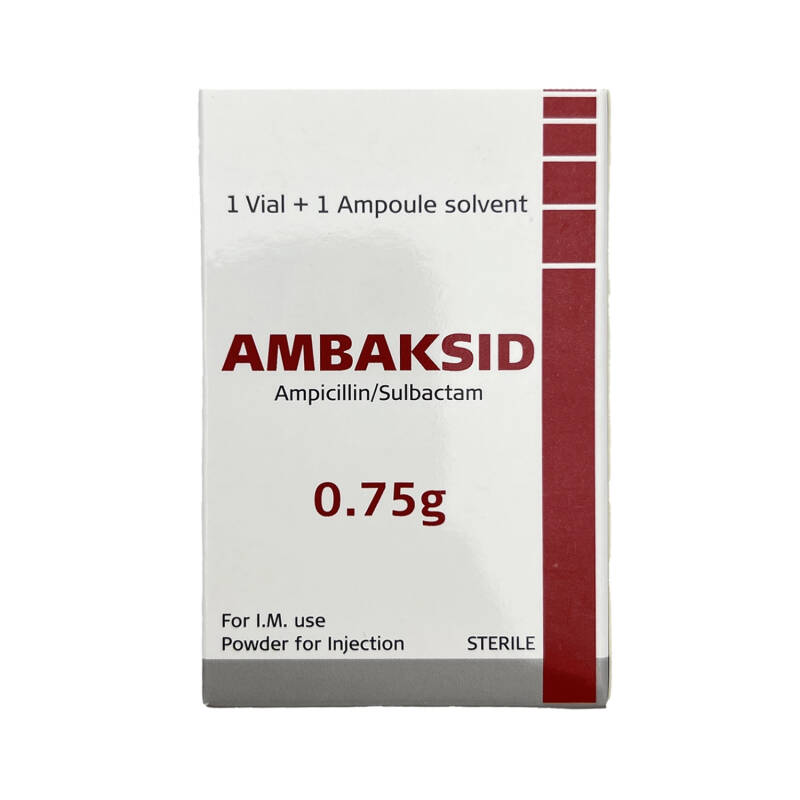
Pharmacodynamics AMBAKSID is a combined antibacterial preparation. It is a semi-synthetic antibiotic from the penicillin group. It has a bactericidal effect by inhibiting the synthesis of the cell wall. It is active against gram-positive, gram-negative and anaerobic bacteria. It is broken down by the action of the beta-lactamase enzyme synthesized by microorganisms, which limits its spectrum of activity. It is ineffective against many major bacterial beta-lactamases; it is an inhibitor of many major bacterial beta-lactamases, increasing the activity and spectrum of ampicillin against those strains. It has very weak antibacterial activity on its own (Neisseriaceae, Acinetobacter spp.). As a result, ampicillin and sulbactam act synergistically.
Aerobic gram-positive microorganisms that produce beta-lactamase and those that do not: Staphylococcus aureus, Staphylococcus epidermidis, Staphylococcus saprophytics, Enterococcus faecalis, Streptococcus pneumoniae, Streptococcus pyogenes and Streptococcus viridans; aerobic gram-negative microorganisms: Haemophilus influenzae, Branhamella catarrhalis, Escherichia coli, Klebsiella spp., Proteus mirabilis, Proteus vulgaris, Neisseria meningitidis, Neisseria gonorrhoeae, Morganella morganii; anaerobic microorganisms: Bacteroides spp. (including Bacteroides fragilis) are highly sensitive to ampicillin/sulbactam. Ampicillin binds to plasma proteins by 28%, and sulbactam by 38%. Both components penetrate well into many organs, tissues and fluids of the organism and are distributed at concentrations in peritoneal and pleural fluids, interstitial fluid, intestinal wall, small pelvic organs, skin and subcutaneous fat tissue. They pass through the barrier poorly; during inflammation of the meninges, permeability increases. The half-life (T1⁄2) of sulbactam is approximately 1 hour. In patients with normal function, 75–85% is excreted unchanged in urine within the first 8 hours. In patients with impaired function, urinary tract infections (pyelonephritis, pyelitis, cystitis, urethritis); infectious-inflammatory diseases of pelvic organs (salpingitis, salpingoophor endometritis); intra-abdominal infections (cholecystitis, peritonitis); • infections of skin and soft tissues (erysipelas, impetigo, abscess, phlegmon); bone and joint infections; sepsis; gonococcal infection; for prophylaxis after surgical operations, as well as after cesarean section and after abortion.
During treatment with ampicillin/sulbactam, hypersensitivity reactions may be observed. Reactions have been observed in people who previously had penicillin reactions or other allergic reactions. Before prescribing, it is necessary to carefully examine the patient’s medical history for whether there is high sensitivity to penicillins, cephalosporins and other substances. If an allergic reaction occurs, treatment with the preparation should be stopped and/or appropriate treatment should be started. Anaphylactic reactions require treatment with epinephrine; if necessary, oxygen (probably after intubation) and intravenous corticosteroids should be administered. During the use of antibacterial preparations, information is available about the development of diarrhea associated with Clostridium difficile (CDAD), ranging from mild diarrhea to colitis resulting in death. For patients with diarrhea with a positive outcome, the possibility of CDAD should be considered. Since development of CDAD has been reported 2 months after completion, careful analysis of the medical history is required, and if there is long-term diarrhea, the prescription of the preparation should be stopped immediately and appropriate treatment should be started. Because it is of viral mononucleosis origin, ampicillin should not be used in treatment. In most patients treated with ampicillin, rashes develop on the skin.
Allopurinol: When used together with ampicillin, the frequency of rash increases. In vitro, co-administration of ampicillin with aminoglycosides causes mutual inactivation. If antibacterial preparations from these groups are used simultaneously, they must be injected into different sites with at least a 1-hour interval. Parenteral penicillins may disrupt platelet aggregation function and coagulation test results; when used simultaneously, these effects may be enhanced: it reduces renal excretion of ampicillin and sulbactam; when used together, the concentrations of active substances in blood increase, the T1⁄2 is prolonged, and the risk of toxicity increases. Preparations (chloramphenicol, erythromycin, sulfonamides, tetracyclines) may affect the bactericidal effect of penicillin, so their simultaneous use should be avoided. (Oral contraceptives): There is information about reduced effectiveness of oral contraceptives and the occurrence of unwanted pregnancy in women using ampicillin.
Despite the weakness of this effect, when using ampicillin, patients should use another or additional method of contraception 1410
Product Filters | ||
|---|---|---|
| Supplier Product Code | : | 111-30292 |
 Powered by
T-SOFT
E-Commerce
Powered by
T-SOFT
E-Commerce