English
Azərbaycan
Русский
49 ₼-dən pulsuz çatdırılma
Sifarişimi izlə
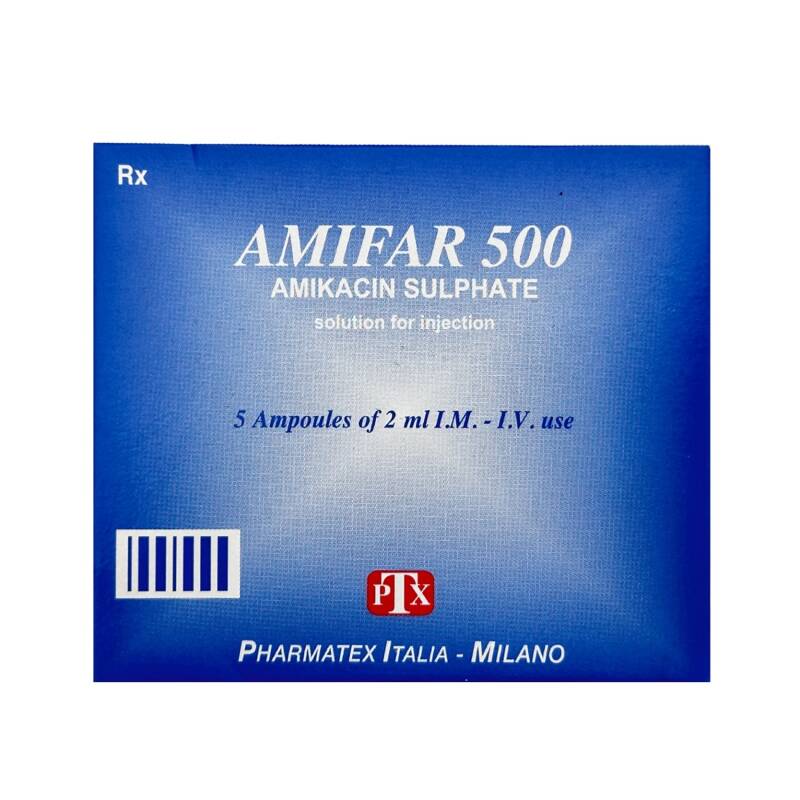
Active ingredient: In 2 ml of solution there is 667.5 mg of amikacin sulfate equivalent to 500 mg of base amikacin. Excipients: sodium citrate tribasic dihydrate, sodium hydroxide, sulfuric acid, sodium metabisulfite, water for injection
Indications for use:
Amifar is used for short-term treatment of severe gram-negative infections, including Pseudomonas aeruginosa, E. coli, Proteus indol + and indol-, Providencia, Klebsiella enterobacter strains, Serratia, and Acinetobacter. It is used in the treatment of the following conditions: − bacteremia, septicemia, and neonatal sepsis; − severe infections of the respiratory system, bone and joint infections, infections of the CNS (including meningitis), intra-abdominal infections (including peritonitis), burns, and post-surgical infections (including vascular surgical infections); − severe and recurrent infections caused by gram-negative microorganisms of the urinary tract. As with other aminoglycosides, amikacin is not used as initial therapy for uncomplicated infections of the urinary tract when the etiologic agent is susceptible to antibacterial agents with less toxic effects; − infections caused by staphylococci: this treatment is used when it is known or suspected which staphylococci caused the infection, and when the patient has an allergy to other antibacterial agents, in cases where the infection is caused by both staphylococci and gram-negative microorganisms. − -neonatal sepsis – when it is not possible to use any other aminoglycoside based on the antibacterial agent sensitivity test. In such cases, because of the possibility of developing superinfections with gram-positive organisms (streptococci and pneumococci), treatment with antibacterial agents from the penicillin group may also be prescribed. Amikacin is active against strains of certain gram-negative bacteria, including Pseudomonas aeruginosa, Proteus rettgeri, Providencia stuartii, and Serratia marcescens, which are resistant to gentamicin, tobramycin, and kanamycin.
Contraindications :
It is contraindicated in patients with an allergic reaction to amikacin or to any other component of the product. In the presence of hypersensitivity in the medical history or when there are known severe, toxic reactions to aminoglycosides, the use of any aminoglycoside is contraindicated due to the possibility of known cross-sensitivity developing to this class of drugs.
Use during pregnancy and lactation:
During pregnancy, Amikacin should be administered to pregnant women and newborn infants only when there is a strict need and under medical supervision. Data on the use of aminoglycosides during pregnancy are limited. Aminoglycosides may have adverse effects on the fetus. Aminoglycosides cross the placenta, and there are reports of complete, irreversible, bilateral congenital deafness in children of mothers who received streptomycin during pregnancy. Although there is no information about adverse effects on the fetus or newborns in pregnant women treated with other aminoglycosides, there is a potential toxic effect. If amikacin is used during pregnancy or if the patient becomes pregnant while taking this medicine, the patient should be informed about the potential risk to the fetus. Lactation: since it is not known whether amikacin is excreted in breast milk, a decision must be made whether to stop breastfeeding and/or discontinue treatment. Fertility: in toxic reproductive studies conducted in mice and rats, there is no information about toxic effects on fertility and the fetus.
Intramuscular and intravenous use When using the recommended doses, uncomplicated infections caused by susceptible organisms should respond to treatment within 24–48 hours. Treatment usually lasts 3–7 days when administered intravenously and 7–10 days when administered intramuscularly. Adults and children: 15 mg/kg/day. The daily dose is divided into two administrations. Infants and/or premature babies: loading dose 10 mg/kg, then 7.5 mg/kg every 12 hours. High-risk infections and/or infections caused by Pseudomonas: For adults, the loading dose may be increased up to 500 mg every 8 hours, but with the condition that it does not exceed 1.5 g/day for no more than 10 days. Total dose must never exceed 15 g. Uncomplicated urinary tract infections (not caused by Pseudomonas): 7.5 mg/kg once daily. Impaired renal function: in patients with impaired renal function, the daily dose should be reduced and/or the intervals between doses should be increased in order to prevent drug accumulation. For patients with suspected or confirmed renal failure, the recommended dosing is determined using the following method: multiply the plasma creatinine concentration by 9, and the obtained result indicates the interval expressed in hours between two doses. Example: if the plasma creatinine level is 2 mg, the recommended dose should be administered every 18 hours. If amikacin is prescribed at a time interval considered appropriate, the plasma concentration of the drug must be monitored so that it does not exceed 35 µg/ml. If this is not possible and the patient’s condition is stable, amikacin may be administered at a high dose of 7.5 mg/kg every 12 hours if the creatinine clearance and creatininemia values are satisfactory. The recommended dose every 12 hours is calculated using the following formula: Maintenance dose = Prescribed CrCl∗ (ml/min) Normal CrCl∗ (ml/min) (every 12 hours) *CrCl—creatinine clearance × 7.5 Alternatively, if the creatininemia value in the “steady state” is known, the normal dose can be divided into several reduced doses and administered every 12 hours using that value. Intramuscular administration is preferred, but if necessary, the same dose schedule may be used for intravenous administration. Intravenous use For adults, for slow venous infusion, a sufficient amount of fluid for normal infusion should be used over 30–60 minutes (100–200 ml for a 500 mg ampoule). If necessary, suitable fluids for intravenous use are: physiological saline, 5% dextrose, and Ringer’s lactate solution. The amount of fluid to be used in children is closely related to the amount of antibacterial agent the child will receive. The infusion fluid should be administered over 30–60 minutes; for infants, this period should be 1 to 2 hours. Suitable fluids for infusion: physiological saline, 5% dextrose, Ringer’s lactate. Amikacin must not be physically mixed with other substances; it should be administered separately according to the established dose schedule.
Product Filters | ||
|---|---|---|
| Supplier Product Code | : | 111-06309 |
 Powered by
T-SOFT
E-Commerce
Powered by
T-SOFT
E-Commerce