English
Azərbaycan
Русский
49 ₼-dən pulsuz çatdırılma
Sifarişimi izlə
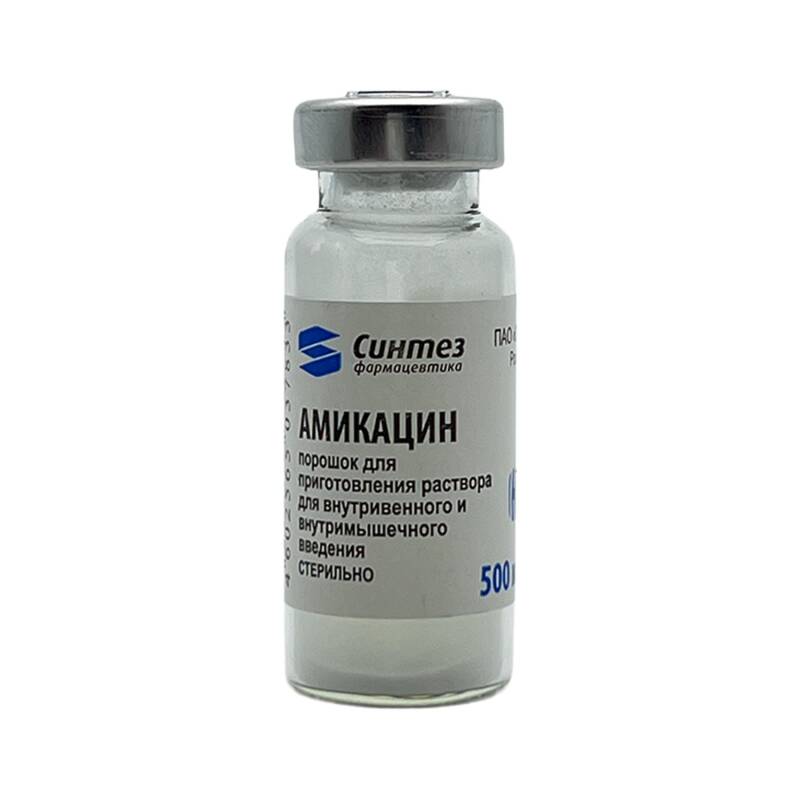
Active ingredient: 1 vial contains 500 mg amikacin sulfate (in terms of amikacin).
Infectious-inflammatory diseases caused by gram-negative microorganisms (resistant to gentamicin, sisomycin, and kanamycin) or by associations of gram-positive and gram-negative microorganisms: respiratory tract infections (bronchitis, pneumonia, empyema of the pleura, lung abscess), sepsis, septic endocarditis, infections of the central nervous system (including meningitis), abdominal cavity infections (including peritonitis), infections of the genitourinary tract (pyelonephritis, cystitis, urethritis, prostatitis), purulent infections of the skin and soft tissues (including infected burns, infected ulcers, and pressure sores of various origins), infections of the biliary tract, bones, and joints (including osteomyelitis), wound infections, and post-operative infections.
High hypersensitivity to amikacin (including other aminoglycosides in the medical history), neuritis of the auditory nerve, severe chronic renal failure accompanied by azotemia and uremia.
Use of amikacin during pregnancy is contraindicated. Amikacin is excreted into breast milk and should not be prescribed to women who feed their infants with breast milk. In cases where it is necessary for the mother to use amikacin during lactation, feeding the infant with breast milk must be stopped before starting treatment.
During treatment, when driving a vehicle and engaging in other potentially dangerous activities that require high concentration of attention and rapid psychomotor reactions, precautions must be observed.
For adults and children over 6 years: IV/IM (by infusion method over 2 minutes or by drip method) — 5 mg/kg every 8 hours or 7.5 mg/kg every 12 hours; for bacterial infections of the urinary tract (without complications) — 250 mg every 12 hours; after a hemodialysis session, an additional dose of 3–5 mg/kg may be prescribed. Maximum doses for adults are 15 mg/kg/day, but not exceeding 1.5 g/day, prescribed for 10 days. Duration of treatment: when administered IV — 3–7 days; when administered IM — 7–10 days. Initial dose in premature newborns — 10 mg/kg, then 7.5 mg/kg every 18–24 hours; in newborns and children under 6 years, the initial dose is 10 mg/kg, then 7.5 mg/kg every 12 hours — the drug is prescribed for 7–10 days.
In patients with burns, considering that the T1/2 value is shorter (1–1.5 hours), it may be necessary to prescribe 5–7.5 mg/kg every 4–6 hours. For IM administration, a solution prepared by adding 2–3 ml of water for injection to the contents of a vial with a dose of 250 mg or 500 mg is used. For IV administration by drip, amikacin should be administered over 30–60 minutes; if necessary, it should be administered by infusion method. For IM administration (by infusion method), a solution prepared by adding 2–3 ml of water for injection or a 0.9% sodium chloride solution or a 5% dextrose solution to the contents of a vial with a dose of 250 mg or 500 mg is used.
For IV administration by drip, the contents of the vial should be diluted in 200 ml of a 5% dextrose solution or a 0.9% sodium chloride solution and then used. The concentration of amikacin in the solution for IV administration must not exceed 5 mg/ml. In cases where renal excretory function is impaired, it is required to reduce the doses of the drug and/or extend the time intervals between administrations. When the time intervals between administrations are extended (if the patient’s condition remains stable, provided that creatinine clearance is not known), the time interval between use is determined as shown below: interval (hours) = serum creatinine concentration × 9.
If the serum creatinine concentration is 2 mg/100 ml, the recommended single dose (7.5 mg/kg) should be administered every 18 hours. If the interval is extended, the single dose is not changed. If the dosing regimen is not changed, the reduction of the single dose applies: in patients suffering from renal failure, the first dose of the drug is 7.5 mg/kg. For calculating subsequent doses, the patient’s creatinine clearance value (ml/min) should be divided by the creatinine clearance value in normal conditions (ml/min), and then the obtained value should be multiplied by the value of the initial dose expressed in mg, i.e.: In a patient, determined creatinine clearance (ml/min) Subsequent dose (mg) = -------------------------------------------- × every 12 hours administered Creatinine clearance in normal conditions initial dose (mg) value (ml/min)
Product Filters | ||
|---|---|---|
| Supplier Product Code | : | 111-01567 |
 Powered by
T-SOFT
E-Commerce
Powered by
T-SOFT
E-Commerce