 EN − AZN

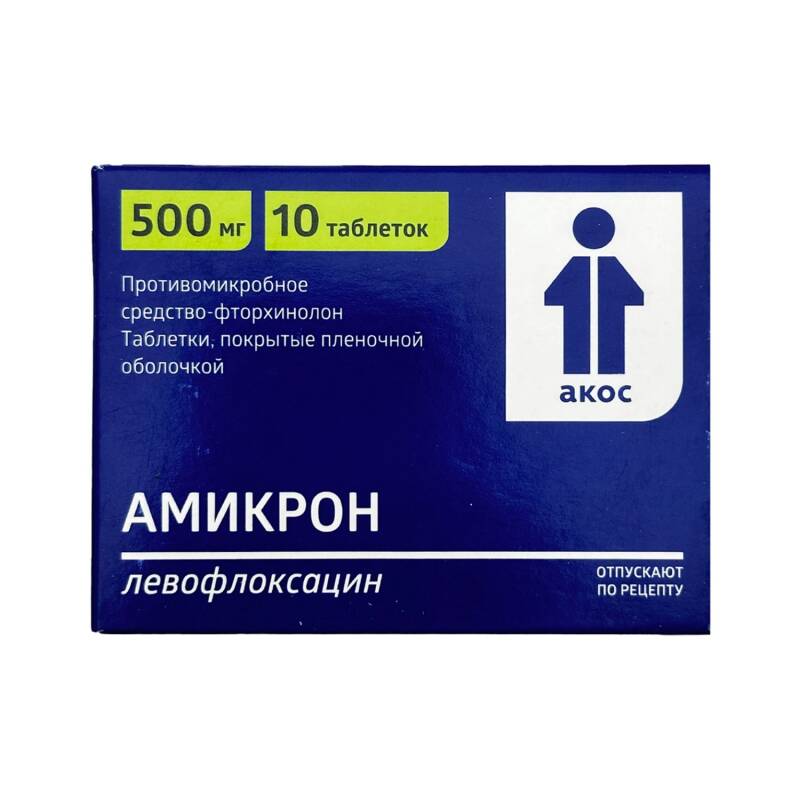
Amikron 500 Mq N10 Tablet
Out Of Stock
Notify me when its in stockAMIKRON, film-coated tablets.
Amikron composition
Active ingredient: 1 tablet contains 500 mg levofloxacin (in the form of levofloxacin hemihydrate). Excipients: calcium stearate, starch 1500, gelatinized potato starch (starch 1500), crospovidone, povidone (low-molecular-weight medical polyvinylpyrrolidone 12600 ± 2700, povidone K 17), lactose monohydrate, talc, colloidal silicon dioxide (aerosil), microcrystalline cellulose M102. Film coating: hypromellose (oxipropylmethylcellulose), macrogol (polyethylene glycol 4000), titanium dioxide (titanium dioxide), tropeolin O.
Indications:
Treatment of infectious-inflammatory diseases caused by microorganisms sensitive to levofloxacin:
− community-acquired pneumonia;
− complicated infections of the urinary tract and pyelonephritis;
− chronic bacterial prostatitis;
− infections of skin coverings and soft tissues;
− as part of complex treatment of drug-resistant tuberculosis forms;
− prophylaxis and treatment of anthrax disease transmitted by the airborne route. Levofloxacin may be used alone, as an alternative to other antimicrobial agents, for the treatment of the following infectious-inflammatory diseases:
− acute sinusitis;
− exacerbation of chronic bronchitis;
− uncomplicated cystitis. When using the Amikron product, it is necessary to take into account the official national recommendations for the appropriate use of antibacterial agents, as well as the susceptibility of the causative pathogens for the specific country (see the sections “Special instructions and precautions”).
Contraindications:
− hypersensitivity to levofloxacin or other quinolones, as well as to any of the excipients included in the Amikron product;
− intolerance to lactose, lactase deficiency, glucose-galactose malabsorption;
− epilepsy;
− pseudoparalytic myasthenia (myasthenia gravis) (see the sections “Adverse effects” and “Special instructions and precautions”);
− when tendon damage has been noted during the use of fluoroquinolones in the medical history;
− children and adolescents under 18 years old (since it is not possible to completely exclude the risk of damage to cartilage growth zones, related to incomplete completion of skeletal growth);
− pregnancy (it is not possible to completely exclude the risk of damage to cartilage growth zones in the fetus);
− breastfeeding (it is not possible to completely exclude the risk of damage to cartilage growth zones in the child).
Use during pregnancy and breastfeeding:
The use of levofloxacin during pregnancy and breastfeeding is contraindicated.
How to use Amikron, dosage
The method of use: Amikron 500 mg tablets should be taken orally 1 or 2 times per day. The tablets should be swallowed whole, without chewing, with a sufficient amount of liquid (from 0.5 to 1 glass). Since food intake does not affect the absorption of the drug, the product may be taken at any time before meals or between meals (see the “Pharmacokinetics” section). The product should be used at least 2 hours before or 2 hours after taking preparations containing magnesium and/or aluminum, iron, zinc, or sucralfate (see the “Interaction with other medicinal products” section). Considering that during the use of Amikron tablets the bioavailability of levofloxacin is 99–100%, the patient should not receive the product as an intravenous infusion; when switching to taking Amikron tablets, treatment should be continued at the same dose that was used during intravenous infusion (see the “Pharmacokinetics” section). If one or more doses are missed If the intake of the product is accidentally missed, the next dose should be taken as soon as possible, and then the use of Amikron should be continued according to the recommended dosing regimen. Dosage and duration of treatment The dosing regimen is determined depending on the nature and severity of the infection, as well as the susceptibility of the suspected pathogen. The duration of treatment varies depending on the course of the disease. In patients with normal renal function (CC > 50 ml/min): Recommended dosing regimen and duration of treatment Community-acquired pneumonia: 1 tablet of Amikron 500 mg 1–2 times per day (500–1000 mg levofloxacin, respectively) – 7–14 days. Complicated infections of the urinary tract: 1 tablet of Amikron 500 mg once per day (500 mg levofloxacin, respectively) – 7–14 days. Pyelonephritis: 1 tablet of Amikron 500 mg once per day (500 mg levofloxacin, respectively) – 7–10 days. Chronic bacterial prostatitis: 1 tablet of Amikron 500 mg once per day (500 mg levofloxacin, respectively) – 28 days. Infections of the skin and soft tissues: 1 tablet of Amikron 500 mg 1–2 times per day (500–1000 mg levofloxacin, respectively) – 7–14 days. Complex treatment of drug-resistant tuberculosis forms: 1 tablet of Amikron 500 mg 1–2 times per day (500–1000 mg levofloxacin, respectively) – up to 3 months. Prophylaxis and treatment of anthrax disease transmitted by the airborne route: 1 tablet of Amikron 500 mg once per day (500 mg levofloxacin, respectively) – up to 8 weeks. Acute sinusitis: 1 tablet of Amikron 500 mg once per day (500 mg levofloxacin, respectively) – 10–14 days. Exacerbation of chronic bronchitis: 1 tablet of Amikron 500 mg once per day (500 mg levofloxacin, respectively) – 7–10 days. Dosing regimen in patients with impaired renal function (CC ≤ 50 ml/min) Levofloxacin is excreted mainly by the kidneys; therefore, when treating patients with impaired renal function, a reduction of the drug dose is required. Dosing regimen in patients with impaired liver function Considering that levofloxacin undergoes only insignificant metabolism in the liver, no correction of the dosing regimen is required in patients with impaired liver function. Dosing regimen in elderly patients No correction of the dosing regimen is required for elderly patients, except in cases where CC decreases to the 50 ml/min value or lower.