English
Azərbaycan
Русский
49 ₼-dən pulsuz çatdırılma
Sifarişimi izlə
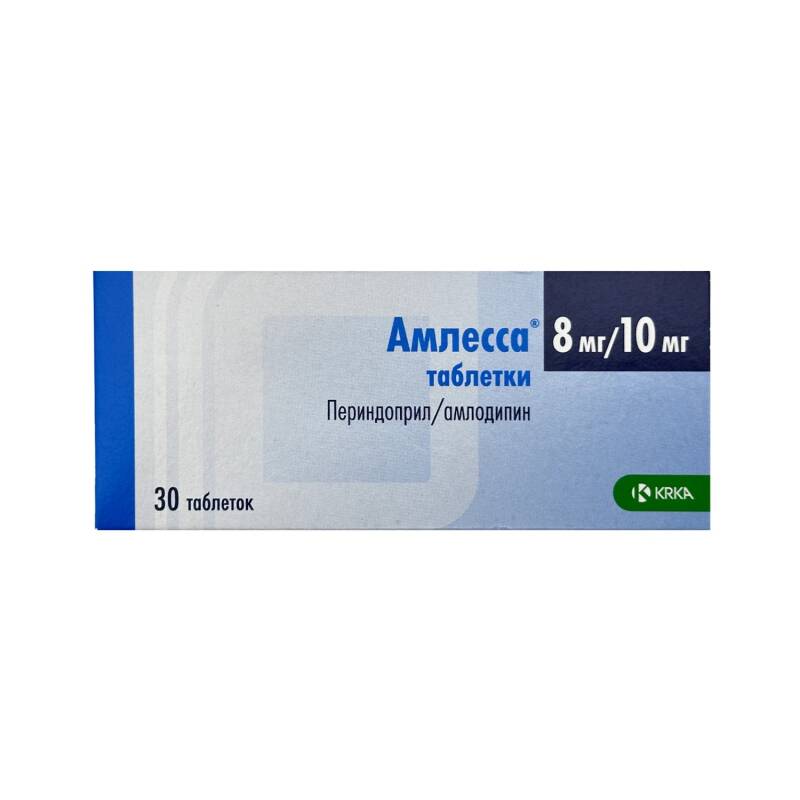
Tablets 8 mg/10 mg: each tablet contains 8 mg perindopril erbumine (tert-butylamine) and 10 mg amlodipine (as bezilate).
Indications:
Amlessa is indicated for the treatment of patients suffering from essential hypertension and/or stable coronary artery disease requiring treatment with perindopril and amlodipine.
Contraindications:
Related to perindopril
• Hypersensitivity to perindopril or ACE inhibitors.
• Angioedema associated with previous therapy with ACE inhibitors in the medical history.
• Hereditary or idiopathic angioedema.
• The second and third trimesters of pregnancy.
• Concomitant use of Amlessa with aliskiren-containing medicinal products in patients with diabetes mellitus or impaired renal function (GFR < 60 ml/min/1.73 m2) (see section “Interactions with other medicinal products”).
• Concomitant administration with combination medicinal products containing sacubitril and valsartan. Treatment with perindopril must be started at least 36 hours after the last dose of the combination medicinal product containing sacubitril and valsartan (also see sections “Special warnings and precautions for use” and “Interactions with other medicinal products”). Amlodipine-related
• Severe hypotension.
• Hypersensitivity to amlodipine or other dihydropyridines.
• Shock, including cardiogenic shock.
• Obstruction of the left ventricular outflow tract (e.g., in severe aortic stenosis).
• Heart failure after an acute myocardial infarction (within the first 28 days). All the contraindications listed above related to each of the components of Amlessa separately also apply to the fixed combination of perindopril/amlodipine.
• Increased hypersensitivity to the excipients of the medicinal product.
Use during pregnancy and lactation:
It is not recommended to take the product in the first trimester of pregnancy. The product is contraindicated in the second and third trimesters of pregnancy. It is not recommended to use the product during lactation. A decision must be made to temporarily discontinue treatment, taking into account either breastfeeding or the importance of the indicated therapy for the mother. Pregnancy Perindopril In the first trimester of pregnancy, taking ACE inhibitors is not recommended. In the second and third trimesters of pregnancy, taking ACE inhibitors is contraindicated. Epidemiological data do not allow a definitive conclusion regarding the risk of teratogenicity when ACE inhibitors are taken in the first trimester of pregnancy, but an increase in risk cannot be ruled out. If ACE inhibitors cannot be replaced with other alternative therapy, women planning pregnancy may be switched to therapy with medicinal products whose safety profile has been well studied for pregnant women. When pregnancy occurs, ACE inhibitor treatment must be stopped immediately and, if necessary, other therapy should be prescribed. During the second and third trimesters of pregnancy, it has been established that exposure to ACE inhibitors can cause fetotoxic effects (impaired kidney function, oligohydramnios, delayed ossification of the skull) and neonatal toxicity (renal failure, hypotension, hyperkalemia). When ACE inhibitors are taken in the second trimester of pregnancy, it is recommended to perform ultrasound monitoring of kidney function and the skull. Newborns whose mothers have taken ACE inhibitors should be closely monitored to prevent the development of hypotension. Amlodipine The safety of amlodipine use in women during pregnancy has not been established. In animal studies, reproductive toxicity has been observed when high doses are administered. It may be considered to use during pregnancy only if there is no safer alternative product and the disease itself poses a significant risk to the mother and fetus. Lactation Perindopril There is no information on the use of perindopril during lactation. The product is not recommended for this category of patients. During breastfeeding, especially when nursing newborns and/or preterm infants, it is recommended to prescribe an alternative medicinal product with a safety profile established. Amlodipine Amlodipine passes into breast milk. The proportion of the dose taken by the mother that affects the child has been estimated at about 3–7%, with a maximum of 15%. The effect of amlodipine on the child is not known. It has been established that calcium channel blockers from the dihydropyridine group are excreted into milk. A decision to continue/stop breastfeeding and/or to continue/stop amlodipine therapy should be made considering the benefit of breastfeeding for the child and the importance of therapy for the mother.
For oral administration. 1 tablet once daily, preferably before breakfast in the morning. The combination of fixed doses is not intended as the starting regimen for antihypertensive therapy. When dose adjustment is required, it is recommended to select the individual components of the medicinal product separately. Patients with impaired renal function and elderly patients In this category of patients, since the elimination of perindopril is slower, routine medical monitoring should include frequent checks of creatinine and potassium levels. Amlessa can be prescribed when creatinine clearance is ≥ 60 ml/min, and is not suitable when creatinine clearance is < 60 ml/min. For such patients, it is recommended to individually select the dose of each component separately. There is no dependence of changes in the plasma concentration of amlodipine on the degree of impairment of kidney function. Patients with impaired liver function No dosage regimen has been established for this category of patients; caution is required when prescribing the specified combination. Children and adolescents Not used, because the safety, efficacy, and tolerability of perindopril and amlodipine have not been studied in this patient population during monotherapy and in combination therapy.
Product Filters | ||
|---|---|---|
| Supplier Product Code | : | 111-20199 |
 Powered by
T-SOFT
E-Commerce
Powered by
T-SOFT
E-Commerce