English
Azərbaycan
Русский
49 ₼-dən pulsuz çatdırılma
Sifarişimi izlə
Each tablet contains 875 mg of amoxicillin (as trihydrate) and 125 mg of clavulanic acid (as potassium salt) (ratio 7:1). Excipients: colloidal anhydrous silicon dioxide, magnesium stearate, microcrystalline cellulose, talc, povidone K25, crospovidone type A, triethyl citrate, hypromellose, talc, titanium dioxide, ethylcellulose, cetyl alcohol, sodium lauryl phosphate.
Amoxiclav is indicated for the treatment of the following infections in adults and children: bacterial sinusitis (properly diagnosed). Exacerbation of acute otitis media bronchitis (properly diagnosed).
Pneumonia. Infections of the skin and soft tissues, mainly inflammation of the subcutaneous tissue, animal bites and wounds, severe dental abscess with spreading phlegmon.
Infections of bones and joints, mainly osteomyelitis.
Hypersensitivity reactions of the immediate type to any of the active or excipients of the product, as well as to other beta-lactam medicinal products (e.g., cephalosporins, carbapenems or monobactams) and to any penicillins (e.g., anaphylaxis). In the patient’s history: jaundice or other liver disorders associated with the use of amoxicillin/clavulanic acid.
There is limited information on the use of the product during pregnancy, which indicates an increased risk of congenital anomalies. The product should not be used. In women with premature rupture of membranes, a potential association was found between prophylactic treatment with amoxicillin/clavulanic acid and a high risk of necrotizing enterocolitis in newborns. If the doctor considers it important, pregnancy… Both
To optimize absorption, the product should be taken immediately before meals. To minimize possible gastrointestinal intolerance and to select the dose of amoxicillin/clavulanic acid for treating the infection, the following factors must be considered: the causative organisms and their possible susceptibility to antibacterial agents, as well as the severity and site of infection.
When age, body weight and kidney function are taken into account, the use of other dosage forms of the product (e.g., higher doses of amoxicillin and/or other ratios of amoxicillin/clavulanic acid doses) should be considered. Adults and children with a body weight > 40 kg are to be taken twice daily at the recommended dose below: 1750 mg amoxicillin/250 mg clavulanic acid; when taken three times daily, the total daily dose corresponds to 2625 mg amoxicillin/375 mg clavulanic acid. For children with a body weight < 40 kg, when taken at the recommended dose below, the maximum daily dose corresponds to 1000–2800 mg amoxicillin/143–400 mg clavulanic acid. If it is recommended to choose another dosage form of the product because a higher daily dose is required, this may involve taking excessively high doses of clavulanic acid. The duration of therapy is determined by the patient’s response to treatment. For infections (e.g., osteomyelitis), adults and children ≥ 40 kg require longer-term therapy. The duration of treatment should not exceed 14 days without reassessment (see information on long-term therapy in the “Special instructions and precautions” section). Recommended doses: standard dose (for all indications) – one tablet twice daily; high dose (for treatment) – one tablet three times daily (especially for infections such as otitis media, sinusitis, and infections of the lower respiratory tract and urinary tract). For children with body weight < 40 kg, for treatment up to the age indicated, it is preferable to use a suspension. For treatment, tablets or other dosage forms of the product, for example a suspension, are used.
6 Recommended doses: 25 mg/3.6 mg/kg/day divided into two doses to 45 mg/6.4 mg/kg/day divided into two doses (e.g., for otitis media, sinusitis and infections of the lower respiratory tract). During treatment of some infections, it is possible to administer up to 70 mg/10 mg/kg/day divided into two doses (mg/kg/day). In the table below, the dose taken when prescribing one tablet for children with body weight 25–40 kg is shown.
Body weight (kg) | Recommended single dose (mg/kg/day) (as stated above) | Amoxicillin (mg/kg/day) | 21.9 | 25.0 | 29.2 | 35.0 | 12.5–22.5 (up to 35) | Single dose (1 tablet) | Clavulanic acid (mg/kg/day) | 1.8–3.2 (up to 5) | per single dose (1 tablet) | should be… For preparing a suspension for the treatment of children weighing less than 25 kg, use the powder medicinal form. Is dose adjustment required? Patients with renal impairment. Patients with creatinine clearance > 30 ml/min: is dose adjustment required? Recommendations have been developed for selecting the dose of the product. In the treatment of patients with creatinine clearance < 30 ml/min using 1000 mg tablets is not used, because this… Patients with hepatic impairment
(See the “Special instructions and precautions” section.) Disorders in the skin and subcutaneous tissues. When any skin allergic reaction develops, treatment should be discontinued: skin rash, itching, urticaria; in some cases: erythema multiforme; frequency: Stevens–Johnson syndrome, toxic epidermal necrolysis, bullous exfoliative dermatitis, acute generalized exanthematous pustulosis, drug reaction with eosinophilia and systemic symptoms (DRESS syndrome).
Disorders in the kidneys and urinary tract. At an unknown frequency: interstitial nephritis. When using crystalluria agents, it is necessary to take into account official guidance. Before starting therapy, a thorough medical history should be collected to identify possible hypersensitivity reactions to penicillins, cephalosporins or other beta-lactam medicinal products. Serious and sometimes fatal hypersensitivity reactions (anaphylactoid reactions) have been observed during therapy. In patients with a high likelihood of penicillin hypersensitivity in their medical history and in atopic patients, reactions may develop. When reactions develop, therapy with Amoxiclav should be discontinued and appropriate other antibacterial medicinal products should be prescribed. When the causative organisms have proven susceptibility to amoxicillin, switching from Amoxiclav to amoxicillin should be considered in accordance with official guidance.
If there is a risk that the causative organisms are susceptible to the inhibitory effect of clavulanic acid but have resistance to beta-lactam medicinal products mediated by beta-lactamases, then this dosage form is considered unsuitable for use. It is not recommended to use this dosage form for the treatment of infections caused by organisms resistant to penicillin. Seizures may occur in patients with impaired renal function or receiving high-dose therapy (see the “Adverse effects” section). When infectious mononucleosis is suspected, avoid therapy with Amoxiclav, because after using amoxicillin, measles-like rash appeared in the context of the above condition. Taking allopurinol concurrently during treatment may potentially increase the likelihood of skin allergic reactions. Long-term use may lead to excessive growth of non-susceptible microorganisms and the development of generalized erythema accompanied by the formation of pustules, which is a potential symptom of acute generalized exanthematous pustulosis (AGEP).
Such a reaction requires discontinuation of therapy with Amoxiclav and is a contraindication to subsequent administration of amoxicillin. Treatment of patients with deficiencies should be carried out with caution. Unwanted events were mainly observed in men and elderly patients and were potentially associated with long-term treatment. This unpleasant condition has also been observed very rarely in children. In all groups, signs and symptoms usually occur during treatment or after treatment, but in some cases they appear only a few weeks after therapy has ended. They are usually reversible. Serious, sometimes fatal unwanted events may develop in patients with severe underlying diseases or those taking medicinal products that can damage the liver. In practice, antibiotic-associated colitis observed during therapy with all antibacterial medicinal products, including amoxicillin, can vary in severity from mild to life-threatening. Therefore, in patients with diarrhea, during any course of antibiotic therapy and after its completion, this diagnosis should be considered. If antibiotic-associated colitis develops, therapy with Amoxiclav should be stopped immediately, the doctor should be consulted, and appropriate treatment should be started.
In this situation, taking medicinal products that stop peristalsis is contraindicated. During therapy, it is recommended to periodically assess the functions of various organ systems, including kidneys, liver and hematopoietic organs. During administration, rarely, prolongation of prothrombin time has been noted. When anticoagulants are taken at the same time, coagulation parameters must be checked reliably. To achieve the desired level, dose correction of oral anticoagulants may be required. In patients with deficiencies, it is important to make dose adjustments according to the level of deficiency (see the “How to use and dosage” section). In patients with reduced diuresis, crystalluria has been observed rarely (mainly in the context of parenteral therapy).
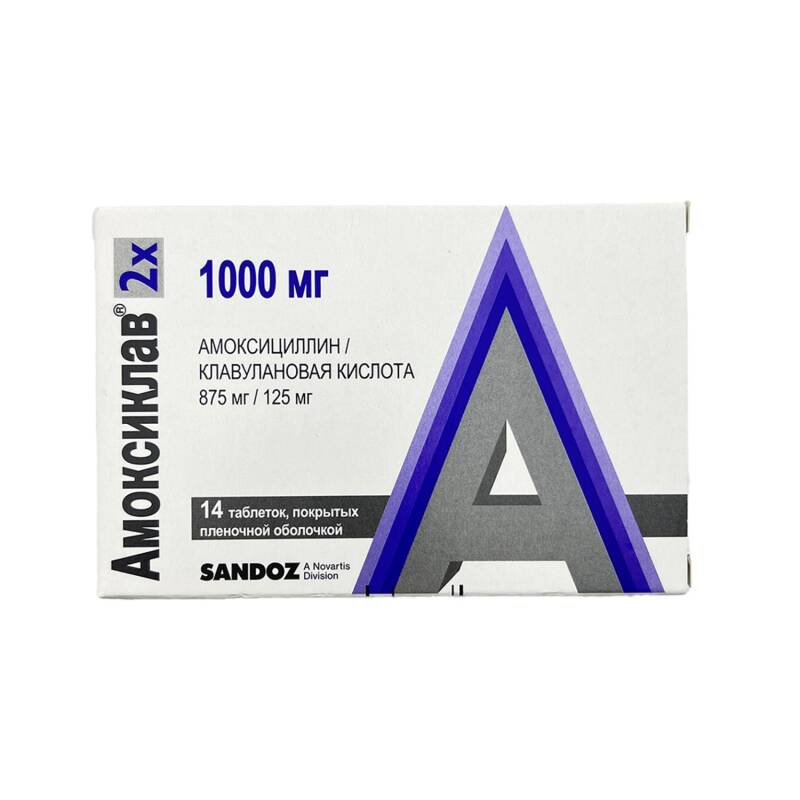
During high-dose therapy with amoxicillin, it is recommended to take a sufficient amount of fluids and monitor diuresis to reduce the likelihood of amoxicillin-associated crystalluria. In patients with a catheter placed in the bladder, it is important to regularly check its patency. If it is necessary to assess the level of glucose in urine during treatment, enzymatic methods using glucose oxidase should be used, because non-enzymatic methods sometimes provide false-positive results. The presence of clavulanic acid may cause non-specific binding of IgG and albumin to the membranes of red blood cells, which can lead to a false-positive result of the Coombs test. Positive results of immunoenzyme analysis (IFA) for Aspergillus have been observed in patients who have received the product. In these patients, it was later determined that there were no infections with Aspergillus etiology. According to the IFA test framework, Neposloda… Amoxiclav… AMOKSİKLAVR2x 1000 mg film-coated tablets
(<1/10,000), unknown frequency. sometimes (≥ 1/1,000 to < 1/100), rarely (≥ 1/10,000 to < …). The following categories are used to classify the frequency of development of adverse effects: very common (≥ 1/10), common (≥ 1/100…). The half-life of amoxicillin is the same as in children from three months to two years; in older children and adults. In small children (including premature newborns), the product should not be taken more than twice a day during the first week of life (due to immaturity of the renal excretion pathway). In elderly patients, because renal function may be impaired, the dose should be selected with caution and, if necessary, renal function should be checked regularly. Impaired renal function. The total plasma clearance of amoxicillin and clavulanic acid decreases in proportion to the decline in renal function; the decrease is more pronounced for amoxicillin than for clavulanic acid. Therefore, during deficiency, the dose should be selected so that excessive accumulation of amoxicillin does not occur in order to maintain adequate levels of clavulanic acid (see the “How to use and dosage” section). Hepatic impairment. In patients with hepatic impairment, the product is prescribed with caution and liver function is checked regularly.
Pharmacodynamics. Amoxicillin is a semi-synthetic penicillin (beta-lactam antibiotic) that inhibits one or more enzymes involved in the biosynthesis of peptidoglycan, an integral component of the bacterial cell wall (often referred to as penicillin-binding proteins). Inhibition of peptidoglycan synthesis leads to loss of cell wall strength, which usually results in cell lysis and death, and is broken down by beta-lactamases produced by resistant bacteria; therefore, it is inactive against microorganisms that produce these enzymes. It is a beta-lactam structurally similar to penicillins.
It inactivates some beta-lactamases and thus prevents inactivation of amoxicillin. The duration for maintaining concentrations above the inhibitory concentration (T>MIC) has been accepted as the main determinant of amoxicillin’s effectiveness. The spread of resistance of different strains is characterized by geographical and time dependence; therefore, local information on antibiotic resistance should be obtained before starting therapy (especially in severe infections). When local indicators of antibiotic resistance call into question the appropriateness of the product for certain types of infections, consult relevant specialists.
Usually susceptible species: Gram-positive aerobes: Enterococcus faecalis, Gardnerella vaginalis, Staphylococcus aureus (methicillin-susceptible strains), coagulase-negative staphylococci (methicillin-susceptible), Streptococcus agalactiae, Streptococcus pneumoniae1, Streptococcus pyogenes and other beta-hemolytic streptococci, Streptococcus viridans group aerobes. Gram-negative aerobes: Capnocytophaga spp., Eikenella corrodens, Haemophilus influenzae2, Moraxella catarrhalis, ---Pasteurella multocid, Bacteroides fragilis, Fusobacterium nucleatum, Prevotella sp. Species in which resistance may develop: Gram-positive aerobes: Enterococcus faecium$. Gram-negative aerobes: Escherichia coli, Klebsiella oxytoca, Klebsiella pneumoniae, Proteus mirabilis, Proteus vulgaris.
Species with natural resistance: Gram-negative aerobes: Acinetobacter spp., Citrobacter freundii, Enterobacter spp., Legionella pneumophila, Morganella morganii, Providencia spp, Pseudomonas spp., Serratia spp., Stenotrophomonas maltophilia. Other microorganisms: Chlamydophila pneumoniae, Clamydophila psittaci, Coxiella burnetti, Mycoplasma pneumoniae. $ In the absence of acquired resistance mechanisms, natural intermediate susceptibility. £ All methicillin-resistant staphylococci are resistant to amoxicillin/clavulanic acid. 1 Infections caused by penicillin-resistant strains of Streptococcus pneumoniae cannot be treated with this dosage form of the product.
2 In some countries of the AB, strains with reduced susceptibility (found at a frequency >10%) have been identified. When amoxicillin and clavulanic acid are at physiological pH, after complete dissolution in water and rapid absorption of both components, the bioavailability of amoxicillin and clavulanic acid reaches approximately 70%. The concentration profile of both components is analogous. The time to reach peak concentration (T) for each substance is approximately 1 hour. In volunteers who took the combination product in the form of 875 mg/125 mg tablets twice daily while fasting, the maximum serum concentrations (Cmax) were 11.64±2.78 µg/ml for amoxicillin and 2.18±0.99 µg/ml for clavulanic acid. The time to reach maximum serum concentration (Tmax) was 1.5 hours (range 1.0–2.5) for amoxicillin and 1.25 hours (range 1.0–2.0) for clavulanic acid. The mean value of the T12 indicator was 1.19±0.21 hours for amoxicillin and 0.96±0.12 hours for clavulanic acid.
After distribution, approximately 25% of the total amount of clavulanic acid in plasma and 18% of the total amount of amoxicillin in plasma are found bound to proteins. Amoxicillin and clavulanic acid are distributed to the gallbladder, abdominal wall tissues, skin, adipose tissue, muscle tissue, synovial and peritoneal fluids, bile and pus. Only small amounts pass into cerebrospinal fluid. They pass into breast milk in trace amounts. Amoxicillin and clavulanic acid are partially excreted in equivalent volumes that do not exceed 10–25% of the initial dose as inactive penicillin acid forms in urine. In the human body, clavulanic acid is intensively metabolized and excreted in urine and feces, as well as in the form of carbon dioxide in exhaled air.
The main route of excretion of amoxicillin is via the kidneys. In addition, clavulanic acid is excreted from the body by both renal and extrarenal mechanisms.
Product Filters | ||
|---|---|---|
| Supplier Product Code | : | 111-28369 |
 Powered by
T-SOFT
E-Commerce
Powered by
T-SOFT
E-Commerce