English
Azərbaycan
Русский
49 ₼-dən pulsuz çatdırılma
Sifarişimi izlə
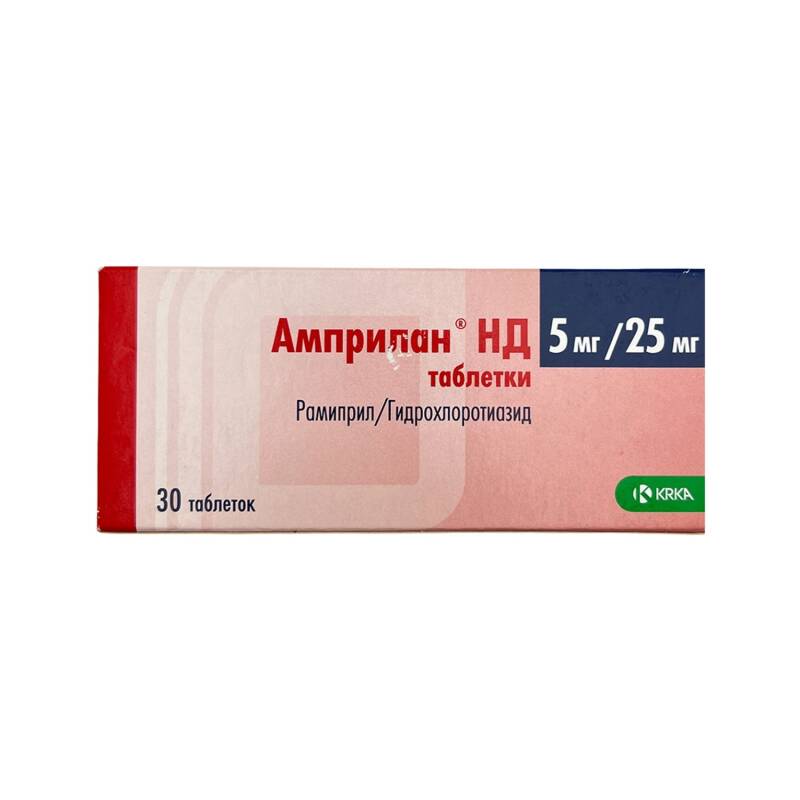
Active substances: 1 tablet contains 5 mg ramipril and 25 mg hydrochlorothiazide.
Arterial hypertension (for patients for whom combination therapy is indicated).
• Hypersensitivity to the active components of the product or to ACE inhibitors, hydrochlorothiazide or other thiazide diuretics, sulfonamides, or to any individual component of the product; • Angioedema associated with the use of ACE inhibitors in the anamnesis, as well as hereditary or idiopathic angioedema; • Extracorporeal treatment that causes contact of blood with negatively charged surfaces; • Bilateral stenosis of the renal arteries or stenosis of the artery of a single kidney; • The second or third trimester of pregnancy; • Lactation period (breastfeeding); • Severe impairment of kidney function in patients not on dialysis (creatinine clearance < 30 ml/min); • Clinically significant disturbances of electrolyte balance that may worsen during treatment with Amprilan HD; • Severe impairment of liver function, hepatic encephalopathy; • Contraindicated for patients with diabetes mellitus or renal failure (GFR < 60 ml/min/1.73 m2) when used together with aliskiren-containing medicinal products as part of Amprilan HD treatment; • Concomitant use with combination medicinal products containing sacubitril and valsartan. Treatment with Amprilan HD must not be started earlier than 36 hours after the last dose of the combination medicinal product containing sacubitril and valsartan.
Amprilan is not recommended in the first trimester of pregnancy; it is contraindicated in the second and third trimesters. There is no definitive epidemiological data regarding the teratogenic risk after taking ACE inhibitors during the first trimester of pregnancy; however, it cannot be ruled out that the risk may increase slightly. If the patient is planning pregnancy, ACE inhibitor therapy should be replaced with alternative antihypertensive agents with an established safety profile for use during pregnancy. If pregnancy is diagnosed, ACE inhibitor therapy must be stopped immediately and, if necessary, alternative treatment should be started.
During the second and third trimesters of pregnancy, treatment with ACE inhibitors/angiotensin II receptor antagonists has been shown to cause fetotoxic effects (decreased kidney function, oligohydramnios, delayed ossification of the fetal skull) and neonatal toxicity (renal failure, arterial hypotension, hyperkalemia). If ACE inhibitors were taken during the second trimester, it is recommended to perform an ultrasound examination of the kidneys and the fetal skull. Newborns whose mothers took ACE inhibitors should be monitored under observation in order to detect hypotension, oliguria, and hyperkalemia in a timely manner. During the third trimester, prolonged exposure to hydrochlorothiazide may cause fetoplacental ischemia and delay fetal development.
In cases where the product is taken by pregnant women, rare cases of hypoglycemia and thrombocytopenia have been reported in newborns. Hydrochlorothiazide may reduce plasma volume and, accordingly, uterine-placental blood flow. During lactation, when medicinal products are used at therapeutic doses, ramipril and hydrochlorothiazide pass into breast milk in sufficient amounts to affect the child. Due to insufficient information about the use of ramipril during lactation, during lactation—especially in newborns and premature infants—alternative treatment methods with an established safety profile are preferred.
Hydrochlorothiazide is excreted in breast milk. Taking thiazides during lactation has been associated with decreased and even impaired lactation. Hypersensitivity reactions may develop to sulfonamide derivatives, hypokalemia, and nuclear jaundice. Because serious reactions related to the effects of both active substances are possible, a decision must be made to either stop breastfeeding or discontinue treatment, taking into account the importance of therapy for the mother.
Amprilan HD does not affect the ability to drive a car or operate machinery; however, in some patients—especially at the beginning of treatment—arterial hypotension and dizziness may occur, which may reduce the ability to drive and operate machinery. Therefore, until the response to treatment is determined, it is necessary to avoid driving, operating machinery, and performing other tasks requiring attention at the beginning of treatment.
Amprilan HD is taken orally once daily at the same time intervals, preferably in the morning, regardless of food intake. The tablets should be swallowed whole with water, without chewing or crushing. The tablet can be divided into two equal parts. It is recommended that adults be prescribed the fixed combination of Ramipril/hydrochlorothiazide individually only after selecting the individual doses of each component separately.
The usual maintenance dose is 1 tablet of Amprilan HD (5 mg ramipril and 25 mg hydrochlorothiazide). If necessary, the dose may be increased gradually to achieve the target blood pressure level; the maximum permitted dose is 10 mg ramipril and 25 mg hydrochlorothiazide per day. For patients who are receiving diuretic therapy, it is recommended to be especially cautious when starting treatment in patients who are taking diuretics at the same time, because there is a risk of developing hypotension. In patients receiving diuretics, it is recommended to discontinue diuretic therapy or reduce the diuretic dose until the start of treatment with Amprilan HD.
Dosage in renal impairment Due to the presence of hydrochlorothiazide, Amprilan HD is contraindicated in severe renal failure (creatinine clearance < 30 ml/min). For patients with impaired kidney function, it may be necessary to reduce the dose of ramipril and hydrochlorothiazide. For patients with creatinine clearance of 30–60 ml/min, only after treatment with ramipril alone, the lowest fixed combination dose of ramipril and hydrochlorothiazide should be prescribed.
Maximum permitted dose is 5 mg ramipril and 25 mg hydrochlorothiazide per day. Patients with hepatic impairment In patients with mild to moderate hepatic impairment, treatment with Amprilan HD should be carried out under strict medical supervision with a maximum daily dose consisting of 2.5 mg ramipril and 12.5 mg hydrochlorothiazide. In severe hepatic impairment, Amprilan HD is contraindicated. Elderly patients Initial doses for elderly patients should be lower, and subsequent dose titration should be carried out gradually, because—especially in elderly patients and in patients with weakened immunity—the likelihood of undesirable effects is higher.
Treatment of children and adolescents Due to insufficient information about the safety and efficacy of the product, Amprilan HD is not recommended for use in children and adolescents under 18 years of age.
Product Filters | ||
|---|---|---|
| Supplier Product Code | : | 111-19663 |
 Powered by
T-SOFT
E-Commerce
Powered by
T-SOFT
E-Commerce