English
Azərbaycan
Русский
49 ₼-dən pulsuz çatdırılma
Sifarişimi izlə
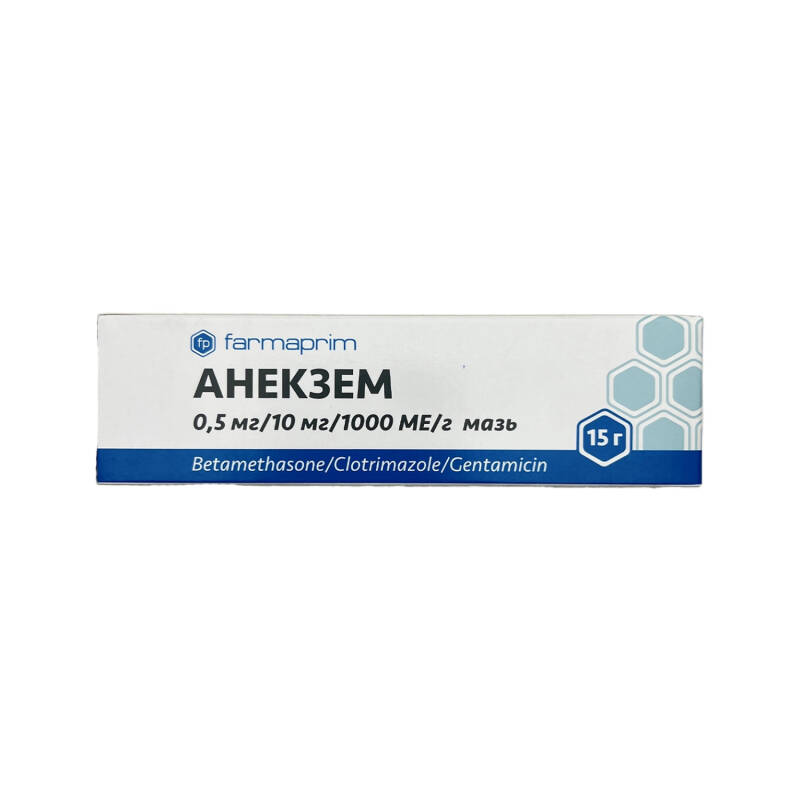
Active substance: 0.5 mg betamethasone (in the form of 0.643 mg betamethasone dipropionate), 10 mg clotrimazole, 1000 IU gentamicin (in the form of gentamicin sulfate) are contained in 1 g of ointment.
For severe, complicated secondary bacterial or fungal infections, or when such risks exist, caused by sensitive dermatoses to corticosteroid therapy, as well as simple and allergic dermatitis, atopic dermatitis, eczema, dermatomycosis, and other conditions sensitive to the active substances of the product.
• Hypersensitivity (allergy) to the active substances of the product, as well as to aminoglycoside antibiotics, to other imidazole derivatives, or to any other components included in the product; • skin infections of viral, bacterial (including tuberculosis) and fungal origin; • skin reactions occurring after vaccination; • skin ulcers; • acne; • rosacea; • perioral dermatitis. Anekzem Ointment must not be applied to mucous membranes, the skin around the eyes, or areas close to the eyes. Anekzem Ointment is not intended for use under occlusive dressings.
In studies conducted on animals, topical use of corticosteroids has shown teratogenic effects. There is no information about use in pregnant women. Aminoglycosides cross the placental barrier and, when used by pregnant women, the product may harm the fetus. There are data regarding congenital irreversible bilateral deafness in children of women who received aminoglycosides, including gentamicin, during pregnancy.
There is insufficient information about the use of clotrimazole in pregnant women. In animal studies, no risk to the fetus was identified. During pregnancy, Anekzem Ointment should be used only if absolutely necessary. The product should not be used over large areas, in large amounts, or for long periods.
During lactation: there is no information about the transfer of gentamicin, clotrimazole, and locally used corticosteroids into breast milk, but the likelihood of corticosteroids that enter the bloodstream passing into breast milk is high. A decision to stop breastfeeding or to discontinue use of the product should be made considering the benefit-risk ratio. When using the product in the area of the breast glands, breastfeeding is contraindicated.
Does not affect the ability to drive vehicles and operate other potentially dangerous machinery.
For external use. Adults and adolescents over 12 years of age. The ointment should be applied in a thin layer to the entire affected surface of the skin and the adjacent areas, morning and evening, 2 times a day, and gently rubbed in. To ensure the effectiveness of treatment, Anekzem ointment should be used regularly.
The duration of treatment depends on the size, location of the affected area, and the response to treatment—based on the results of clinical and microbiological examinations. In adults, the duration of treatment should not exceed 3 weeks. In children over 12 years of age, the duration of treatment should not exceed 5 days. For tinea pedis (athlete’s foot), longer-term treatment (2–3 weeks) may be considered.
Children from 2 to 12 years of age: apply a small amount of ointment only to the affected skin area and rub carefully. That area should not be covered. Use no more than 2 times per day, with a minimum interval of 6–12 hours between each use. The duration of treatment is limited to 5 days.
The ointment should be applied to the face, neck, scalp, genital and rectal areas, as well as to the skin’s intertriginous areas, only under medical supervision.
Product Filters | ||
|---|---|---|
| Supplier Product Code | : | 111-28563 |
 Powered by
T-SOFT
E-Commerce
Powered by
T-SOFT
E-Commerce