English
Azərbaycan
Русский
49 ₼-dən pulsuz çatdırılma
Sifarişimi izlə
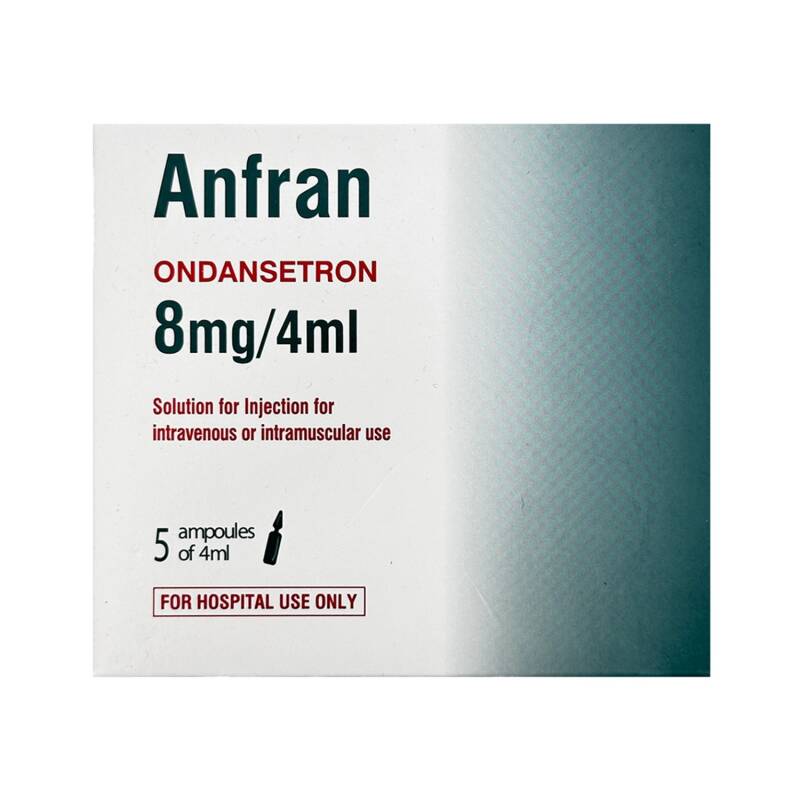
In 1 ml of solution there are 2 mg ondansetron hydrochloride dihydrate. Excipients: citric acid monohydrate, sodium chloride, sodium citrate, water for injection
Anfran injection is used for the treatment of nausea and vomiting caused by cytotoxic chemotherapy and radiotherapy. It is also used for the prevention and treatment of nausea and vomiting that may occur after surgery.
Hypersensitivity to any component of the product.
Psychomotor
Anfran can be administered orally, which allows easier dosing and use according to its purpose; the remaining amount should be discarded. The released product must not be stored. As soon as the ampoule is opened, Anfran ampoules should be administered either as an injection or as an infusion. Anfran ampoules are autoclaved and used for nausea and vomiting caused by radiotherapy and chemotherapy. In adults, the emetogenic (vomit-inducing) effect may vary to different degrees depending on the dose and combination of medicinal products used in chemotherapy and radiological therapy for cancer treatment.
In emetogenic chemotherapy and radiological therapy, the dose range of Anfran injection is 8–32 mg per day and is selected as shown below: The recommended dose for intravenous or intramuscular administration is 8 mg administered slowly as a single dose immediately before treatment. To prevent delayed or prolonged vomiting, oral administration is recommended. In chemotherapy with a high emetogenic effect, for patients receiving high-dose emetogenic chemotherapy (e.g., cisplatin), Anfran may be given as a single dose of 8 mg intravenously or intramuscularly immediately before treatment. When doses greater than 8 mg up to 32 mg are prescribed, they should be diluted with infusion solutions (e.g., physiological saline or other suitable solutions that can be administered into a vein—see pharmacological prophylaxis) to 50–100 ml and infused for at least 15 minutes. Alternatively, Anfran can be administered as a single 8 mg intravenous dose slowly immediately before chemotherapy, or as an intramuscular dose, and the next 8 mg dose can be continued by intravenous or intramuscular administration selected at 2–4 hour intervals depending on the severity of the emetogenic condition, or a fixed infusion can be performed at a rate of 1 mg/hour for up to 24 hours. During high emetogenic chemotherapy, to enhance the effect of Anfran, an additional single intravenous dose of 20 mg dexamethasone sodium phosphate may be administered immediately before treatment. For the prevention of delayed or prolonged vomiting, it is recommended. For adolescents and children (6 months–17 years) with a body surface area of 0.6–1.2 m², Anfran is administered as a single intravenous dose of 5 mg/m² immediately before chemotherapy, followed by continuation with an oral 4 mg dose after 12 hours, with a total of 4 mg twice daily; this regimen may be continued for up to 5 days after the course of treatment. For children with a body surface area greater than 1.2 m², Anfran is administered as an initial intravenous dose of 8 mg immediately before chemotherapy, followed by continuation with an oral 8 mg dose after 12 hours, with a total of 8 mg twice daily; this regimen may be continued for up to 5 days after the course of treatment. As an alternative, for children aged 6 months and older, Anfran may be administered as a single intravenous dose of 0.15 mg/kg immediately before chemotherapy (not exceeding 8 mg). This dose can be repeated every 4 hours as 3 total doses, with 4 mg twice daily; the regimen may be continued for up to 5 days after the course of treatment. The total dose should not be exceeded.
In the elderly, Anfran is well tolerated in patients over 65 years of age as well; there is no need to adjust the doses, their frequency, or the route of administration. Nausea and vomiting that occur after surgery in adults: For prophylaxis of postoperative nausea and vomiting, the recommended dose of Anfran is a single 4 mg slow intravenous injection during induction of anesthesia, or a single 4 mg intramuscular injection. For the treatment of subsequent nausea and vomiting, a single 4 mg slow intravenous injection or intramuscular injection is recommended. In children: In pediatric patients undergoing surgical procedures under general anesthesia, for prophylaxis and treatment of postoperative nausea and vomiting, Anfran may be administered before induction of anesthesia or during induction, as well as after surgery, as a slow intravenous injection in a dose range from 0.1 mg/kg up to a maximum of 4 mg. For prophylaxis and treatment of postoperative nausea and vomiting, in the elderly, limited experience has been reported in patients with renal impairment, but Anfran is well tolerated in patients over 65 years of age who receive chemotherapy.
In patients with acute hepatic impairment, there is no need to adjust the daily doses, their frequency, or the route of administration. In patients with hepatic impairment, the clearance of Anfran is significantly reduced, and the elimination half-life is noticeably prolonged; therefore, the dose may not differ compared with other patients. The dose and its total amount should be adjusted accordingly.
Anfran injection should not be mixed with other medicinal products in the same syringe or in an infusion solution not intended for it. The injection should be used only in the composition of the recommended infusion solutions (information is provided below). Compatibility with intravenous solutions: According to good pharmacological practice, intravenous solutions should be prepared at the start of infusion. It has been shown that Anfran injection, which cannot be stored, maintains its stability at room temperature (25°C) or in a refrigerator for seven days when mixed together with the following named intravenous infusion solutions: Intravenous 0.9% sodium chloride solution; Intravenous 5% glucose solution; Intravenous 10% mannitol solution; Intravenous Ringer’s solution; Intravenous 0.3% potassium chloride and 0.9% sodium chloride solution; Intravenous 0.3% potassium chloride and 5% glucose solution. There is information that patients with hypersensitivity to other selective 5HT3 receptor antagonists may also be hypersensitive to this product. Rarely, during intravenous administration of Anfran, changes that pass through the ECG as a dominant phenomenon, especially prolongation of the QT interval, have been observed. Since it delays the passage of intestinal contents, when prescribing to patients with signs of incomplete intestinal obstruction, the process should be monitored. Safety information: Studies on cloned human heart channels showed that Anfran has the potential to affect cardiac repolarization by blocking the HERG potassium channels.
The clinical significance of this finding has not been established.
When Anfran is used together with other medicinal products, there is usually no information that it increases or decreases the metabolism of these products. Studies have shown that when Anfran is administered together with alcohol, temazepam, tramadol or propofol, there is no pharmacological interaction between them. It is metabolized by the liver through multiple cytochrome P450 enzymes: CYP3A4, CYP2D6, CYP1A2. Due to the presence of multiple metabolic enzymes in the metabolism of Anfran, when inhibition of any one of them occurs or its activity decreases (e.g., genetic deficiency of CYP2D6), the others compensate in normal conditions, and this has little effect on the overall clearance of Anfran or on changing its dose, or causes no significant change. In patients treated with strong inducers of CYP3A4 (e.g., phenytoin, carbamazepine and rifampicin), the oral clearance of Anfran increased and the concentration in blood decreased. Limited data from a few studies indicate that Anfran may reduce the analgesic effect of tramadol. Compatibility: Anfran can be administered intravenously at 1 mg/hour via an infusion container or syringe pump. Medicinal products can be administered together with Anfran at concentrations of 16–160 micrograms/ml (e.g., 8 mg/500 ml, 8 mg/50 ml): cisplatin up to 0.48 mg/ml (e.g., 240 mg in 500 ml) for more than 1 hour up to 8 hours; 5-fluorouracil up to 0.8 mg/ml (e.g., 2.4 g in 3 l or 400 mg in 500 ml) at a rate of at least 20 ml/hour (500 ml/24 hours).
Higher concentrations of 5-fluorouracil may cause precipitation of Anfran. During infusion of 5-fluorouracil, in addition to the ingredients contained in it, magnesium chloride 0.045% may be added at concentrations in the range of 0.18–9.9 mg/ml (e.g., 90 mg in 500 ml, 990 mg in 100 ml) for more than 10 minutes up to 1 hour; etoposide at concentrations in the range of 0.144–0.25 mg/ml (e.g., 72 mg in 500 ml, 250 mg in 1 l) for more than 30 minutes up to 1 hour; ceftazidime at the manufacturer’s prepared dose—dissolved in water for infusion (e.g., 2.5 ml for 250 mg, 10 ml for 2 g ceftazidime) and administered as an intravenous bolus dose, injected over approximately more than 5 minutes; at the manufacturer’s prepared dose—dissolved in water for infusion for 100 mg to 1 g (100 mg cyclophosphamide - 5 ml water) and administered as an intravenous bolus dose, injected over approximately more than 5 minutes; at the manufacturer’s prepared dose—dissolved in water for infusion for 10–100 mg (10 mg doxorubicin - 5 ml water) and administered as an intravenous bolus dose, injected over approximately more than 5 minutes.
Pharmacodynamics Anfran is a highly selective, potent antagonist of 5HT3 receptors. The exact mechanism of action that prevents nausea and vomiting is not fully known. It may prevent the initiation of the vomiting reflex by causing the release of 5HT in the small intestine through activation of vagal afferent pathways via 5HT3 receptors. This reflex may be initiated by blockade. It may also lead to the release of 5HT at the bottom of the fourth ventricle, which in turn can lead to the central mechanism of vomiting. The mechanism by which Anfran prevents nausea and vomiting resulting from cytotoxic chemotherapy and radiotherapy is due to antagonism against 5HT3 receptors on neurons localized in the central and peripheral nervous systems. The mechanism of action for preventing subsequent nausea and vomiting is not known, but it is possible that the mechanism involves cytotoxic nausea and vomiting. Does it change the plasma concentration of prolactin? When Anfran is administered orally, intramuscularly or intravenously, terminal elimination is similar; the half-life is 3 hours, and the volume of distribution is approximately 140 l. After intramuscular and intravenous administration, equivalent systemic exposure occurs. It does not form a very high degree of binding with plasma proteins (70–76%). Anfran is cleared by hepatic metabolism with the help of multiple enzymes from the systemic circulation; less than 5% of the dose is excreted unchanged in urine. The absence of the 2D6 (debrisoquine polymorphism) enzyme affects Anfran pharmacokinetics. Pharmacokinetic characteristics do not change with repeated dosing. Studies in healthy volunteers have shown that bioavailability and the half-life increase slightly with age, with no clinical significance. The presence of sex differences in dosing has been shown: after oral dose intake in women, absorption is faster and more extensive, and this is due to a decrease in systemic clearance and volume of distribution (adjusted for body weight). In a clinical study, Anfran was administered at doses of 0.1 or 0.2 mg/kg to 51 pediatric patients aged 1–24 months before surgery.
In patients aged 1–4 months (normalized for body weight), clearance was about 30% slower compared with patients aged 5–24 months, but the half-life compared with patients aged 3–12 years was 6.7 hours in the 1–4 month group, and 2.9 hours in the 5–24 month group compared with patients aged 3–12 years. For patients aged 1–4 months, there is no need to adjust the dose for the treatment of postoperative nausea and vomiting, and the recommended regimen is based on the fact that only a single intravenous dose of Anfran is used. Differences in the characteristics can be partially explained by the wide distribution volume in the 1–4 month group. In a study in patients aged 3–12 years undergoing selective surgical procedures under anesthesia, in 21 pediatric patients, the absolute values of Anfran clearance and volume of distribution were reduced compared with adults, and the single intravenous dose was 2 mg (for 3–7 years) or 4 mg (for 4–8 years). These two parameters increased linearly with weight up to 12 years of age and reached values comparable to those of adolescents. When the volume of distribution is normalized by body weight, applying the dose based on similar values across different age groups (0.1 mg/kg up to a maximum of 4 mg) compensates for these changes, and this is effective in normalizing systemic exposure in pediatric patients. In a study of 74 patients aged 6–48 months, Anfran was administered intravenously at 0.15 mg/kg every 4 hours, 3 doses per day, for the treatment of nausea and vomiting caused by chemotherapy. In addition, in patients aged 1–24 months (41 surgical patients), Anfran was administered as a single intravenous dose of 0.1 mg/kg or 0.2 mg/kg. Studies in humans have shown that Anfran is not recommended in these cases because human pregnancy is not relevant. It has been shown that Anfran should not be used in lactating animals, and it is recommended that mothers receiving Anfran do not feed their children with breast milk. No sedative effect of Anfran has been detected.
Very frequent (>1/10), frequent (>1/100, <1/10), occasional (>1/1000, <1/100), rare (>1/10,000, <1/1000), very rare (<1/10,000). In addition to the information included, the incidences identified as frequent, frequent, occasional cases are determined mainly based on clinical practice data, and rare cases are usually identified after marketing. The stated frequencies were assessed according to standard recommendations in accordance with Anfran’s indications and form. System pathologies: Rare: sometimes acute hypersensitivity reactions, including anaphylaxis, occurring suddenly.
Nervous system disorders: Very frequent: headache, seizures, movement disorders (including extrapyramidal reactions such as oculomotor crisis, dystonic reactions and dyskinesias with no persistent clinical consequences). Rare: dizziness during the period of rapid intravenous injection; Rare: temporary visual disturbances during the period of intravenous injection (e.g., blurred vision).
Very rare: during the period of intravenous injection, most cases of temporary blindness resolve within 20 minutes. Most of the cases were in patients receiving chemotherapy including cisplatin. There was information that some cases of blindness were of cortical origin.
Cardiac disorders: Occasional: arrhythmias, ST segment depression, or pain in the chest without it; bradycardia.
Vascular disorders: Frequent: feeling of heat; hypotension system; disorders of the chest and intercostal space. Occasional: hiccups. Frequent: constipation.
Hepatobiliary disorders: Occasional: asymptomatic increase in the results of liver function tests. These cases are often observed in patients receiving chemotherapy with cisplatin. Disorders and condition of the injection site: Frequent: local reaction at the site of intravenous injection.
Product Filters | ||
|---|---|---|
| Supplier Product Code | : | 111-15757 |
 Powered by
T-SOFT
E-Commerce
Powered by
T-SOFT
E-Commerce