English
Azərbaycan
Русский
49 ₼-dən pulsuz çatdırılma
Sifarişimi izlə
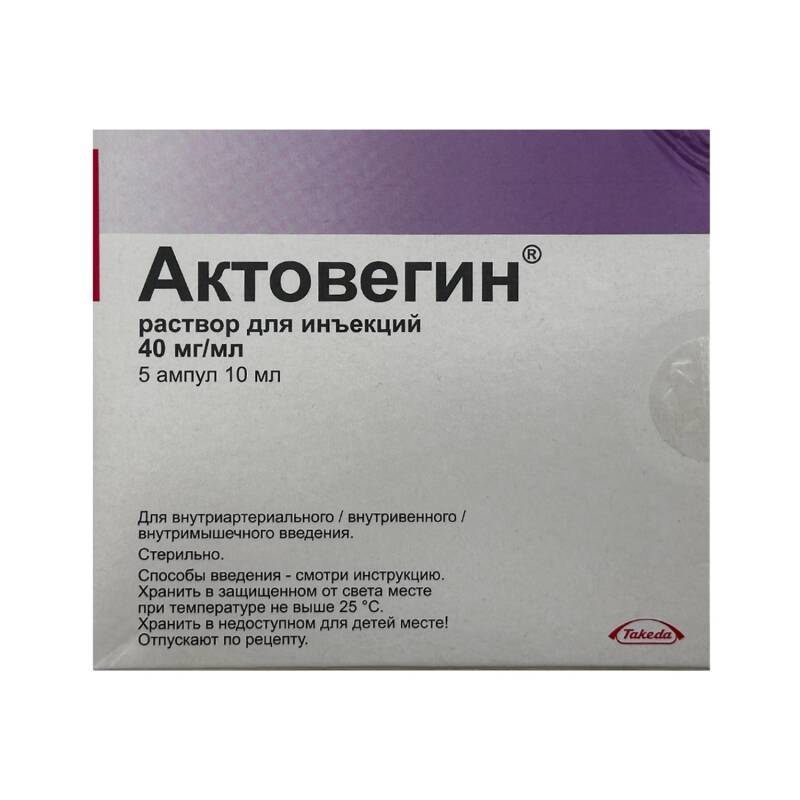
Active substance: 1 ampoule (2 ml) contains 80.0 mg Actovegin concentrate (deproteinized hemoderivative from calf blood) 1). Excipients: water for injection, 1 M hydrochloric acid. Active substance: 1 ampoule (5 ml) contains 200.0 mg Actovegin concentrate (deproteinized hemoderivative from calf blood) 1). Excipients: water for injection, 1 M hydrochloric acid. Active substance: 1 ampoule (10 ml) contains 400.0 mg Actovegin concentrate (deproteinized hemoderivative from calf blood) 1). Excipients: water for injection, 1 M hydrochloric acid solution. 1) Actovegin concentrate contains sodium chloride in the form of sodium and chloride ions, which are components of calf blood. During the production process of the concentrate, sodium chloride is neither added nor removed. The amount of sodium chloride is approximately 53.6 mg (for 2 ml ampoules), approximately 1340 mg (for 5 ml ampoules) and approximately 268.0 mg (for 10 ml ampoules).
Indications for use:
As part of complex therapy: symptomatic treatment of cognitive disorders, including cognitive disorders after stroke, including dementia. Symptomatic treatment of disorders of peripheral blood circulation and their complications. Symptomatic treatment of diabetic polyneuropathy (DPN).
Contraindications:
Hypersensitivity to the Actovegin preparation and similar preparations or to excipients. Decompensated heart failure, pulmonary edema, oliguria, anuria, fluid retention in the body. Children under 18 years of age.
Use during pregnancy and lactation:
Actovegin can be used only in cases where the potential therapeutic benefit for the fetus or child outweighs the potential risk.
Can be added to solutions for intra-arterial, intravenous, intramuscular administration, and for infusion. Instructions for use of breakable-point ampoules: Place the ampoule tip with the point facing upward. Carefully tap the ampoule with your finger and shake the ampoule to ensure that the solution flows down from the ampoule tip. Place the ampoule tip with the point facing upward. Break the ampoule tip in the manner shown in the figure. Depending on the severity of clinical manifestations, first 10–20 ml of the preparation is administered intravenously or intra-arterially daily; then 5 ml is administered slowly intravenously or intramuscularly, daily or several times per week. For administration as an infusion, 10–50 ml of the preparation is added to 200–300 ml of the base solution (isotonic sodium chloride solution or 5% glucose solution). The infusion rate is approximately 2 ml/min. For intramuscular injections, up to 5 ml of the preparation is used; since the solution is hypertonic, the preparation must be administered slowly. Post-stroke cognitive disorders In the acute period of ischemic stroke, starting from days 5–7, by intravenous drip method, up to 20 infusions at 2000 mg per day, then 2 tablets, 3 times per day (1200 mg/day). Total duration of treatment is 6 months. Dementia 2000 mg per day by intravenous drip method for 4 weeks. Disorders of peripheral blood circulation and their complications 800–2000 mg per day intra-arterially or intravenously by drip method. Duration of treatment up to 4 weeks. For patients with stage III chronic obliterating diseases of the arteries of the lower extremities, efficacy and safety of the preparation were studied with 1200 mg per day by intravenous drip method for 2 weeks, and then 1–2 tablets, 3 times per day for up to 10 weeks. Diabetic polyneuropathy 20 infusions of 2000 mg per day by intravenous drip method, then 3 tablets, 3 times per day (1800 mg/day); duration of treatment is 4–5 months.
Product Filters | ||
|---|---|---|
| Supplier Product Code | : | 111-20615 |
 Powered by
T-SOFT
E-Commerce
Powered by
T-SOFT
E-Commerce