English
Azərbaycan
Русский
49 ₼-dən pulsuz çatdırılma
Sifarişimi izlə
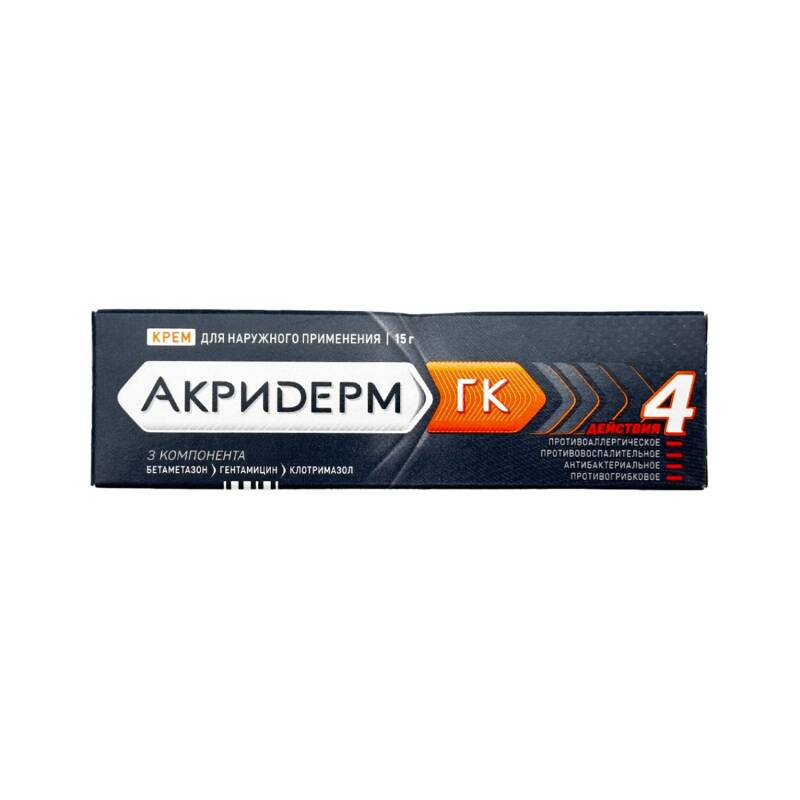
Ingredients: In 100 g of cream, 0.05 g of betamethasone equivalent to 0.064 g betamethasone dipropionate (betamethasone dipropionate is micronized) and 0.100 g gentamicin in the form of gentamicin sulfate, and 1.000 g clotrimazole (calculated as 100% substance). Excipients: petroleum jelly, propylene glycol, liquid paraffin, cetostearyl alcohol (cetyl alcohol 60%, stearyl alcohol 40%), macrogol cetostearyl ether (macrogol-20 cetostearyl ether), disodium edetate, sodium dihydrogen phosphate dihydrate, purified water. Transdermal absorption of betamethasone during application is very insignificant and depends on the condition of the epidermal barrier (inflammation and skin diseases increase absorption). The use of occlusive dressings increases transdermal absorption of betamethasone and gentamicin, which makes it possible for a relatively larger amount of the systemic component to be absorbed, and therefore systemic effects may occur.
High sensitivity to any component of the product, skin tuberculosis, skin manifestations of syphilis, chickenpox, simple herpes (herpes), post-vaccination skin reactions, open wounds, and childhood (up to 2 years).
It is not known whether the components of the product penetrate into breast milk; therefore, when prescribing Akriderm GK cream during lactation, it is recommended to avoid continuing breastfeeding and to stop feeding with breast milk. It is important to avoid the risk of developing bacterial or fungal microflora; if such microflora develops, treatment with the product should be discontinued and appropriate treatment should be started.
In children, the ratio of the area of skin covering to body weight is greater than in adults, and also because the epidermis is not sufficiently developed, when using the product for external application
Some side effects may reduce psychomotor reactions and the ability to concentrate, and in this regard the risk may increase in situations where these abilities are especially important (for example, when driving a car or other machinery). How to use and dosage: For external use, apply a thin layer by gently rubbing onto the affected area of the skin. Pharmacotherapeutic group: topical glucocorticosteroid + antibiotic (aminoglycoside) + antifungal. Apply 2 times a day; the duration is determined individually and depends on the indication and severity.
Pharmacodynamics: This is a combined product with anti-inflammatory, anti-allergic, antibacterial, and antifungal (fungicidal) effects. It is an aminoglycoside antibiotic with a broad spectrum of action. Bactericidal activity is due to high sensitivity of gram-negative microorganisms to the product: Proteus spp. (indole-positive and indole-negative), Escherichia coli, Klebsiella spp., Salmonella spp., Shigella spp., Campylobacter spp., Staphylococcus spp. (methicillin-resistant). Sensitive microorganisms include Enterococcus faecalis, Serratia spp., Pseudomonas spp., Acinetobacter spp., Citrobacter spp.
Resistant microorganisms include Neisseria meningitidis, Treponema pallidum, and Streptococcus spp. (except Streptococcus pneumoniae), Enterococcus faecalis. Providencia rettgeri. Glucocorticosteroid: has local anti-inflammatory, anti-edema, and anti-allergic effects.
Clotrimazole is an antifungal agent from the imidazole derivatives group for topical use. It acts by disrupting the synthesis of ergosterol, which is a component of the cell membrane. It has activity against dermatophytes (Trichophyton rubrum, Trichophyton mentagrophytes, Epidermophyton floccosum, Microsporum canis), yeast and mold fungi (Candida spp., Torulopsis glabrata, Rhodotorula spp., Pityrosporum orbiculare). When the product is used on the skin in therapeutic doses
may increase the risk of development. Indications for use: simple and allergic dermatitis (especially when complicated by secondary infection), diffuse neurodermatitis (including atopic dermatitis), limited neurodermatitis (including simple chronic herpes), eczema, dermatomycosis (dermatophyte, candidiasis, tinea versicolor), especially when localized in the groin area and in large skin folds. There is a high risk of development; the product should be used for the shortest possible time and with all precautions. It depends on the nosological form and severity. For dermatomycosis, the average duration of treatment is 2–4 weeks. If clinical improvement does not occur, it is important to change the diagnosis and/or treatment regimen. Clarify. Itching, burning, irritation, dry skin, folliculitis, hypertrichosis, steroid acne, hypopigmentation, allergic reactions. When using dressings: maceration, infection, skin atrophy, striae. During prolonged use or when applied to a large surface area — systemic effects: weight gain, osteoporosis, increased arterial blood pressure, edema, impaired visual acuity, ulcers of the mucous membrane of the gastrointestinal tract, exacerbation of latent infection foci, hyperglycemia, irritability, insomnia, dysmenorrhea.
Use with caution
Product Filters | ||
|---|---|---|
| Supplier Product Code | : | 111-18470 |
 Powered by
T-SOFT
E-Commerce
Powered by
T-SOFT
E-Commerce