English
Azərbaycan
Русский
49 ₼-dən pulsuz çatdırılma
Sifarişimi izlə
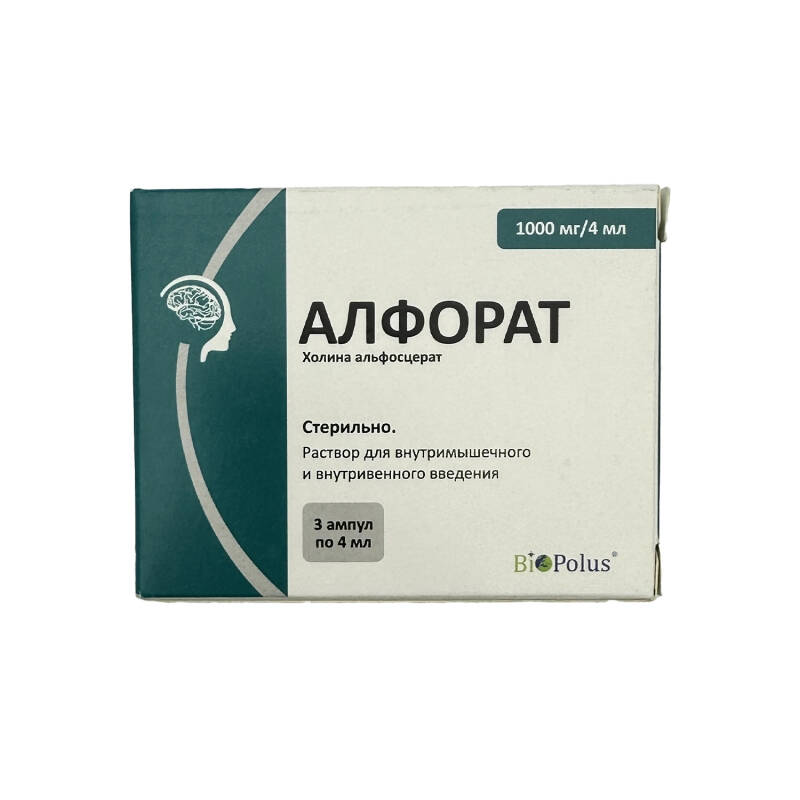
Each ampoule (4 ml) contains 1000 mg choline alfoscerate. Excipients: water for injection.
Ischemic and hemorrhagic stroke (early and delayed recovery period); traumatic brain injury (especially acute period with damage at the brainstem level—impaired consciousness, focal hemispheric symptomatology, symptoms of brainstem injury); chronic cerebrovascular insufficiency (dyscirculatory encephalopathy); recovery period after hemorrhagic stroke; degenerative or involutional brain psycho-organic syndrome and complication of cerebrovascular insufficiency, ischemic and dementia (Alzheimer’s, senile, mixed forms), Alzheimer’s disease; Huntington’s chorea; Cognitive disorders: initial and secondary impairment of thinking functions, including during dementia and encephalopathy, characterized in elderly individuals by memory impairment, clouding of consciousness, disorientation, decreased motivation and initiative, and reduced ability to concentrate; Pseudomelanchoia and changes in the behavioral sphere: emotional instability, irritability, decreased interest; old age
Hypersensitivity to choline alfoscerate; hemorrhagic stroke (acute phase);
Children under 18 years of age.
During treatment, it is necessary to avoid driving vehicles and engaging in other potentially dangerous activities that require high attention and rapid psychomotor responses.
When prescribed as intramuscular and intravenous injection, the recommended dose is 1 ampoule per day (1000 mg/4 ml) administered intramuscularly (slowly) or intravenously (by drip method). During administration, the contents of 1 ampoule (4 ml) are dissolved in 50 ml of 0.9% sodium chloride solution. The infusion rate is 60–80 drops per minute. The course duration is usually 10–15 days. The duration of the course is determined by the physician, taking into account the disease, the patient’s response to the medication, and the achieved effect.
Pharmacodynamics: Choline alfoscerate mainly stimulates central cholinoreceptors (exhibits a cholinomimetic effect). It stimulates neurotransmission by providing, as a substrate, the synthesis of acetylcholine and phosphatidylcholine in the membrane from choline and glycerophosphate. It improves neuronal membrane plasticity and receptor function, activates cerebral blood flow, stimulates metabolism in the CNS and the reticular formation, raises mood, improves mental activity, concentration, memory, and the ability to reproduce received information, optimizes cognitive and behavioral responses, and helps normalize cerebral blood flow and the bioelectric activity of the brain in the damaged area during the acute period of traumatic brain injury, leading to regression of neurological symptoms. Absorption, distribution, and elimination: When administered, choline alfoscerate is absorbed and passes easily, with approximately 88% of the administered dose on average. The preparation accumulates mainly in the brain (45% of the concentration in blood plasma), as well as in the lungs and liver, and is eliminated from the body. In the body, choline alfoscerate undergoes biotransformation under the action of enzymes into choline and glycerophosphate (which ensures the pharmacological effect of the preparation). 85% is excreted by the lungs in the form of carbon dioxide; the remaining part (15%) is excreted in urine and feces.
Nausea may occur (mainly as a result of dopaminergic activation); in this case, the dose of the preparation is reduced.
No clinically significant interactions of the preparation with other medicinal products have been identified.
As a rule, the preparation is well tolerated by patients. Disorders of the digestive system: constipation, diarrhea, nausea, dryness of the oral mucosa. Disorders in the pharyngeal system: headache, drowsiness, insomnia, aggressiveness, agitation, irritability, cerebral ischemia, seizures, disorders in the area of the head/covering: rash, urticaria.
Other: pain at the injection site, increased urination.
Product Filters | ||
|---|---|---|
| Supplier Product Code | : | 111-29928 |
 Powered by
T-SOFT
E-Commerce
Powered by
T-SOFT
E-Commerce