English
Azərbaycan
Русский
49 ₼-dən pulsuz çatdırılma
Sifarişimi izlə
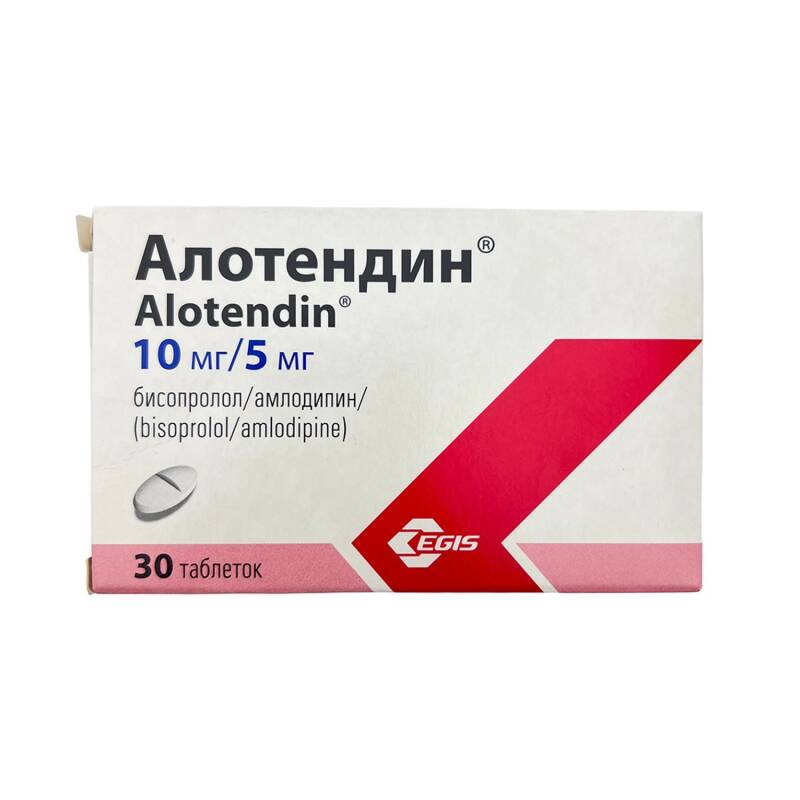
Active substance: Each tablet contains 5 mg bisoprolol fumarate and 5 mg amlodipine (as 6.95 mg amlodipine besylate).
- Treatment of arterial hypertension as monotherapy and, if necessary, in combination with other antihypertensive medicinal products. - Treatment of chronic stable angina as monotherapy and, if necessary, in combination with other antianginal agents. The Alotendin product is indicated as replacement therapy in patients whose blood pressure and/or chronic stable angina can be adequately controlled during combined use of amlodipine and bisoprolol in separate tablet forms at the same doses.
Related to amlodipine: - Severe hypotension, - obstruction of blood flow from the left ventricle (severe aortic stenosis), - shock (including cardiogenic shock), - hemodynamically unstable heart failure after myocardial infarction. Related to bisoprolol: - Acute heart failure and/or episodes of heart failure requiring intravenous inotropic medicinal products, - cardiogenic shock, - second- or third-degree AV block (without an electrocardiostimulator), - sick sinus syndrome, - sinoatrial block, - clinically significant bradycardia, - clinically significant arterial hypotension, - severe bronchial asthma, - severe forms of occlusive diseases of peripheral arteries and severe form of Raynaud’s syndrome, - untreated pheochromocytoma (“See the section Special warnings and precautions for use”), - metabolic acidosis. Related to the Alotendin product: hypersensitivity to the active substances (bisoprolol, amlodipine), to dihydropyridine derivatives and/or to any of the excipients contained in the product.
Pregnancy Bisoprolol has pharmacological effects that may adversely affect pregnancy and/or the fetus/newborn. In general, β-blockers reduce placental perfusion, which can lead to impaired fetal growth, intrauterine death, spontaneous abortion, and premature delivery. Additional effects (e.g., hypoglycemia and bradycardia) may be observed in the fetus and newborn. When treatment with β-blockers is necessary, selective β1-blockers are preferred.
The safety of amlodipine in human pregnancy has not been established. In animal studies, reproductive toxicity was observed when high doses of amlodipine were used. Unless there is a serious indication during pregnancy, the use of the Alotendin product is not recommended. When treatment with Alotendin is considered necessary, uteroplacental blood flow and fetal growth should be monitored carefully.
If there is an adverse effect on pregnancy or the fetus, alternative treatment should be considered. Newborns should be monitored carefully. Symptoms of hypoglycemia and bradycardia are generally expected within the first 3 days. Lactation Amlodipine is excreted into human breast milk.
Approximately 3–7% of the dose taken by the mother (interquartile range, maximum 15%) enters the child’s body. It is not known whether bisoprolol is excreted in human breast milk. Therefore, the use of the Alotendin product during lactation is not recommended. Fertility There is no information on the effect of the combined product on human fertility.
In some patients treated with calcium channel blockers, reversible biochemical changes have been observed in the heads of spermatozoa. Clinical data are insufficient to assess the possible effect of amlodipine on fertility. Experimental data show that bisoprolol does not affect fertility or reproductive capacity in animals. In a published experimental study, the effect of amlodipine on the fertility of male rats has been described.
Amlodipine may have a minor effect on the ability to drive vehicles and operate machinery. In patients taking amlodipine, if dizziness, headache, fatigue, or nausea occur, their ability to react may be impaired. In a study involving patients with ischemic heart disease, bisoprolol did not impair the ability to drive vehicles or operate other potentially dangerous machinery. However, considering the variability of individual responses to this medicinal product, the ability to drive vehicles and operate machinery may be impaired.
This effect is most commonly observed at the beginning of treatment, when treatment is changed, and when alcohol is used at the same time.
The Alotendin product is indicated for patients in whom high blood pressure and/or coronary artery pathology can be adequately controlled during the simultaneous use of monocomponent medicinal products at the recommended fixed combination doses. Dosage regimen The recommended daily dose consists of one tablet of the specified strength. Treatment should not be stopped abruptly, as this may lead to a temporary worsening of the clinical condition. In particular, treatment should not be stopped abruptly in patients with ischemic heart disease.
Gradual dose reduction is recommended. In patients with impaired liver function, the elimination of amlodipine may be reduced. There are no precise recommendations regarding the amlodipine dose; therefore, in such patients the product should be used with caution (“See the section Special warnings and precautions for use”). In severe hepatic impairment, the daily dose of bisoprolol should not exceed 10 mg.
In patients with impaired renal function In patients with mild to moderate renal insufficiency, dose adjustment is not required. Amlodipine is not eliminated by hemodialysis. In severe renal impairment (creatinine clearance less than 20 ml/min), the daily dose of bisoprolol should not exceed 10 mg. Elderly patients Elderly patients may be prescribed the usual doses of the product, but doses should be increased with caution.
Children and adolescents under 18 years The safety and efficacy of the Alotendin product have not been established in children and adolescents under 18 years of age. Such data are not available. Instructions for use Tablets are taken orally. It is recommended to take Alotendin tablets in the morning, without chewing, regardless of food intake.
Product Filters | ||
|---|---|---|
| Supplier Product Code | : | 111-16457 |
 Powered by
T-SOFT
E-Commerce