English
Azərbaycan
Русский
49 ₼-dən pulsuz çatdırılma
Sifarişimi izlə
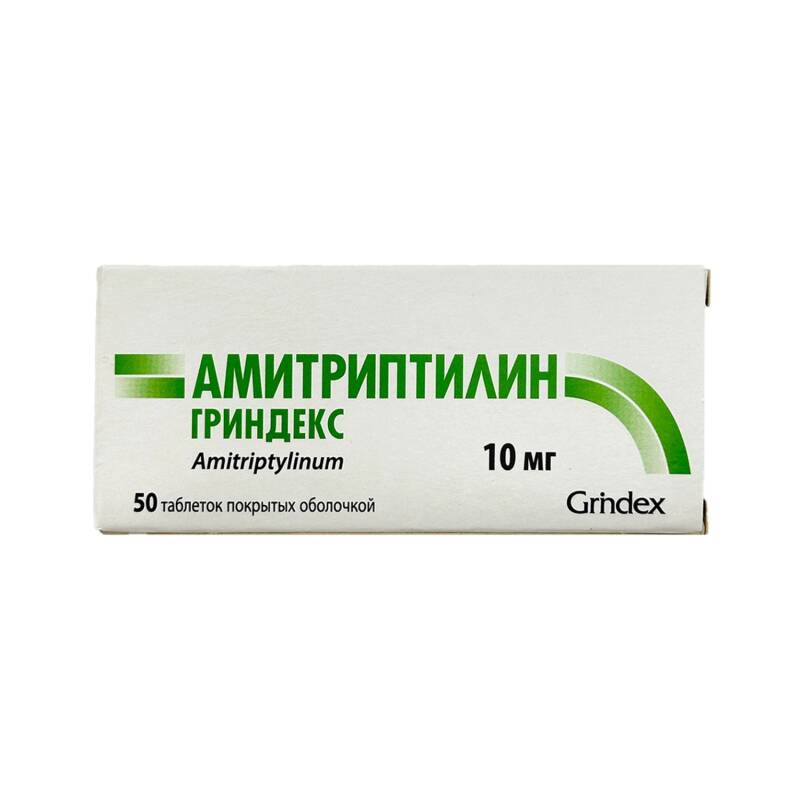
Active substance: In 1 tablet there is 10 or 25 mg amitriptyline hydrochloride. Excipients: lactose monohydrate, corn starch, povidone (polyvinylpyrrolidone), silicon dioxide, magnesium stearate. Amitriptyline Qrindeks 10 mg: blue Opadry II 85F20753 dye substance (polyvinyl alcohol, titanium dioxide (E 171), macrogol PEG 3000, talc, indigo carmine (E 132), Ponso 4 R (E 124), quinoline yellow (E 104)), carnauba wax. Amitriptyline Qrindeks 25 mg: yellow Opadry II 85F22450 dye substance (polyvinyl alcohol, macrogol PEG 3000, quinoline yellow (E 104), talc, titanium dioxide (E 171), “sunset yellow” yellow (E 110), indigo carmine (E 132)), carnauba wax.
Indications:
Amitriptyline Qrindeks tablets are used in the following cases: ➢ Treatment of severe depressive episodes in adults; ➢ Treatment of neuropathic pain in adults; ➢ Prophylaxis of chronic tension-type headache (chronic tension type headache, XGBA) in adults; ➢ Prophylactic treatment of migraine in adults; ➢ In the absence of organic pathology, treatment of nocturnal enuresis in children from the age of 6 years, including spina bifida and related disorders, when and only when there is no response to all other types of treatment, with or without medication use, including antispasmodic preparations and preparations related to vasopressin. This product may be prescribed only by a healthcare professional who has information for permanent enuresis control.
Contraindications:
High sensitivity to any component of the product. Recently experienced myocardial infarction. Any type of block or disturbance of heart rhythm, as well as coronary artery insufficiency. Concurrent use with MAO inhibitors (monoamine oxidase inhibitors) is contraindicated. Concurrent prescribing of MAO inhibitors with amitriptyline may lead to the development of serotonin syndrome (with symptoms including agitation, confusion, tremor, myoclonus and hyperthermia, and possible overlap of symptoms). Treatment with amitriptyline may be started 14 days after discontinuation of non-reversible non-selective MAO inhibitors, and at least 1 day after taking the reversible MAO inhibitor moclobemide. MAO inhibitors may be started 14 days after discontinuation of amitriptyline. Severe liver diseases. Porphyria in children under 6 years of age.
Use during pregnancy and lactation:
The patient should consult a doctor before using this product during pregnancy, while breastfeeding, or when planning pregnancy. The use of amitriptyline during pregnancy is contraindicated except in cases where the doctor considers it essential after carefully assessing the benefit/risk ratio. At the end of pregnancy, when using the product, newborns may develop anticholinergic symptoms such as irritability, hypertension, tremor, irregular breathing, difficulty swallowing, crying loudly, delayed urination, and constipation. Amitriptyline and its metabolites pass into breast milk. The risk cannot be ruled out in breastfed infants. The doctor must decide whether to start/continue/stop breastfeeding after assessing the benefit/risk ratio for the patient and the child.
Amitriptyline Qrindeks method of use, dosage
The product must always be used as prescribed by the doctor. If there is any doubt, you should contact the doctor. Not all dosing regimens of medicines are implemented with any pharmaceutical form/dosage aid. The appropriate pharmaceutical form/dosage should be selected for the initial dose and for increasing the dose subsequently. Severe depressive episodes Adults The recommended dose is 25 mg twice daily. Depending on the patient’s response to the medicine, the doctor may increase the dose gradually, divided into two intakes, up to 150 mg. Elderly patients over 65 years and patients with cardiovascular diseases The initial dose is 10–25 mg per day. Depending on the patient’s response to the medicine, the doctor may increase the dose gradually, divided into two intakes, up to 100 mg. If the patient takes 100–150 mg per day, it may be necessary for the doctor to assess the patient’s condition frequently. Children and adolescents This medicine should not be given to children and adolescents for the purpose of treating depression. Neuropathic pain, prophylaxis of chronic tension-type headache treatment and prophylaxis of migraine treatment The doctor should choose the dose according to the patient’s symptoms and response to treatment. Adults The recommended starting dose is 10–25 mg in the evening. The recommended daily dose is 25–75 mg. Depending on the patient’s response to the medicine, the doctor may increase the dose gradually. When the received dose exceeds 1000 mg per day, it may be necessary for the doctor to assess the patient’s condition frequently. The doctor should instruct to take the dose once daily or divide it into two intakes. Elderly patients over 65 years and patients with cardiovascular diseases The recommended starting dose is 10–25 mg in the evening. Depending on the patient’s response to the medicine, the doctor may increase the dose gradually. When the received dose exceeds 75 mg per day, it may be necessary for the doctor to examine the patient. Children and adolescents This medicine should not be used in children and adolescents for the treatment of neuropathic pain, prophylaxis of chronic tension-type headache treatment, and prophylaxis of migraine treatment. Nocturnal enuresis Recommended dose in children: up to 6 years: see the “Contraindications” section; children aged 6–10 years: 10–20 mg per day. In this age group, a more suitable dosage form should be used; children aged 11 years and older: 25–50 mg per day. The dose should be increased gradually. The medicine should be taken 1–1.5 hours before bedtime. Before starting treatment, the doctor should perform an ECG of the patient to check for signs of changes in heart rhythm. Treatment cannot be stopped without discussing with the doctor. Patients at special risk People with liver diseases or those referred to as “slow metabolizers” usually take a smaller dose of the product. Route of administration Tablets are intended for oral use. Tablets are swallowed with water. Duration of treatment Without consulting the doctor, you must not change the dose of the product or stop treatment. Severe depressive episodes As with other medicines used to treat depression, it may take several weeks until the patient feels any improvement. The duration of treatment during depression therapy is individual; usually it is 6 months. The duration of treatment is determined by the doctor. The medicine should be taken for as long as the doctor recommends. The underlying condition may persist for a long time. If the patient stops treatment early, symptoms may return. Neuropathic pain, prophylaxis of chronic tension-type headache treatment and prophylaxis of migraine treatment It may take several weeks for any improvement in the patient’s health. The patient should consult the doctor about the duration of treatment and continue using it as recommended. Nocturnal enuresis After a 3-month course, the doctor should decide whether to continue treatment.
Product Filters | ||
|---|---|---|
| Supplier Product Code | : | 111-00783 |
 Powered by
T-SOFT
E-Commerce
Powered by
T-SOFT
E-Commerce