English
Azərbaycan
Русский
49 ₼-dən pulsuz çatdırılma
Sifarişimi izlə
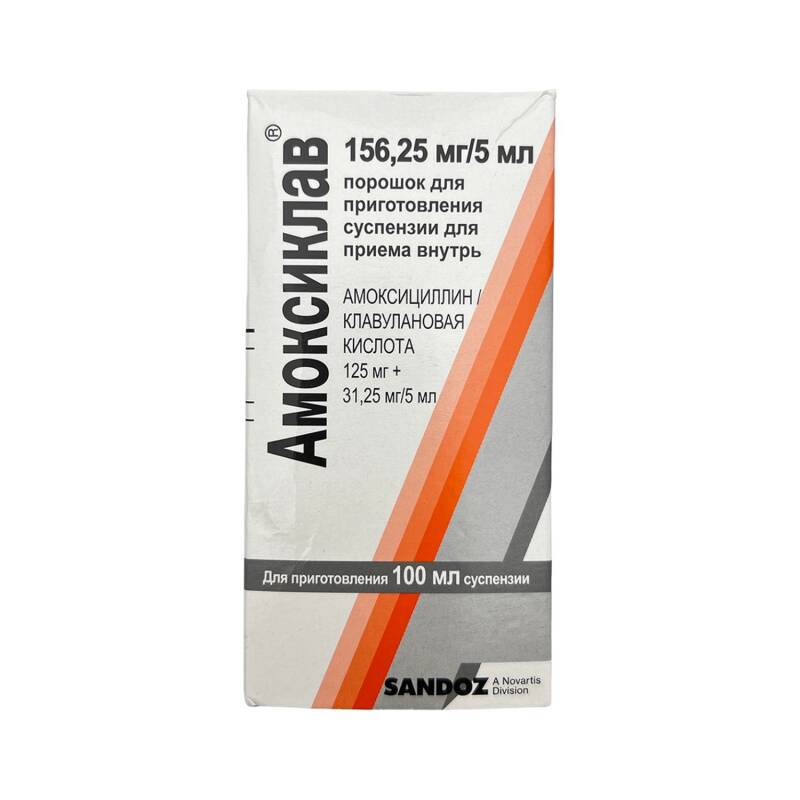
contains 125 mg of amoxicillin (as trihydrate) and 31.25 mg of clavulanic acid (as potassium salt) in 5 ml of suspension (4:1). Excipients include colloidal silicon dioxide, xanthan gum, strawberry flavouring maltodextrin, crospovidone, aspartame, sodium carboxymethylcellulose, silicon dioxide (anhydrous silicon dioxide). passes into breast milk (
• Infections of the upper respiratory tract (including ear-nose-throat), especially acute sinusitis, otitis media, recurrent tonsillitis; Infections of the lower respiratory tract, especially exacerbations of chronic bronchitis and bronchopneumonia; Community-acquired pneumonia. Infections of the genital and urinary tracts: e.g., cystitis, urethritis, pyelonephritis, female genital infections. Infections of the skin and soft tissues: e.g., inflammation of subcutaneous tissue, wounds resulting from animal bites, severe tooth abscess accompanied by spreading phlegmon; Infections of bones and joints: e.g., osteomyelitis.
For immediate severe hypersensitivity reactions (e.g., anaphylaxis) to the active substance or excipients of the product, as well as to all penicillins and other beta-lactam medicinal products (e.g., cephalosporins, carbapenems or monobactams). In the patient’s history: jaundice or other liver damage during the use of amoxicillin/clavulanic acid. " and "
Animal studies did not show any direct or indirect effects on embryo-fetal development, labour, or postnatal development during pregnancy. Limited results regarding the use of the product indicate a high risk of congenital anomalies. In women where the membranes rupture prematurely, a potential association has been identified between prophylactic treatment with amoxicillin/clavulanic acid and a high risk of necrotizing enterocolitis in newborns. The product should be avoided unless the doctor prescribes it. Treatment with both medicinal products is possible only after assessing the benefit/risk ratio of the product.
There is no information about the effects of clavulanic acid on children). During lactation, children may develop diarrhoea and fungal infections of the mucous membranes, which may require stopping breastfeeding.
Not studied; the occurrence of undesirable effects that could potentially affect these functions (e.g., allergic reactions, dizziness, seizures) is possible.
If it is not stated that the dose corresponds to the amount of the single component, the dose indicates the amount of amoxicillin/clavulanic acid. When choosing a dose for the treatment of infections, the following factors must be considered: the expected pathogens and their possible susceptibility to antibacterial agents; severity and location of the infection; age, body weight and renal function of the patient. When other medicinal forms are needed (e.g., higher doses of amoxicillin and/or other doses of amoxicillin/clavulanic acid), the product should be taken according to the recommendations below. For adults and children with body weight ≥ 40 kg, the total daily dose is 1500 mg amoxicillin/375 mg clavulanic acid; for children with body weight < 40 kg, the daily dose is 2400 mg amoxicillin/600 mg clavulanic acid. If a higher daily dose is required, use another medicinal form of the product to avoid excessively high daily doses of clavulanic acid. The duration of the counter-response treatment should be determined. Infections (e.g., osteomyelitis) require longer-term treatment. The duration must not exceed 14 days without reassessment. (" The product should be used immediately before meals to reduce undesirable symptoms that may be produced by the gastrointestinal tract and to enhance the absorption of amoxicillin/clavulanic acid.
According to the instructions, treatment may be started with the parenteral forms of the medicinal product and continued with oral forms. Preparation: Usually the suspension is prepared by the pharmacist at the pharmacy. The suspension should be homogeneous, from white to yellow. Before use, check the seal on the cap. To soften, shake the vial. Add 98 ml of water: in two portions (first 2/3, wait 5 minutes after shaking, then add up to the marked line) and shake the suspension well each time. Any unused medicinal product residues are disposed of according to local requirements.
Disorders in the system are not known: angioedema, anaphylaxis, serum sickness-like syndrome, allergic vasculitis. Disorders: dizziness, headache. Not known: reversible hyperactivity, seizures, disorders in the meninges. Common: nausea (especially associated with oral administration at high doses), (if the medicinal product is taken immediately before meals, undesirable effects that may be produced by the gastrointestinal tract are reduced to a minimum), vomiting, diarrhoea.
Not known: gastrointestinal disorders—antibiotic-associated colitis (including pseudomembranous and haemorrhagic colitis), “black hairy” tongue, discoloration of teeth (very rarely, in children, changes in the surface colour of teeth have been observed). Proper oral hygiene prevents changes in the colour of tartar; because the tartar formed can usually be removed with a toothbrush. Disorders in the liver and biliary tract: Not known—elevations of AST and/or ALT levels (in patients treated with antibiotics from the beta-lactam group, a mild increase has been reported, but the significance of these observations is unknown). Not known: hepatitis, cholestatic jaundice (these undesirable effects have been observed in the context of the use of other penicillins and cephalosporins, "
Pharmacodynamics Amoxicillin is a semi-synthetic penicillin (a beta-lactam antibiotic). It inhibits one or more enzymes involved in the biosynthesis of peptidoglycan, an integral component of the bacterial cell wall (usually enzymes known as penicillin-binding proteins). Inhibition of synthesis leads to disruption of the cell wall strength, which results in cell lysis and death. It is broken down under the action of beta-lactamases produced by resistant bacteria, therefore it is inactive against microorganisms that produce these enzymes. Clavulanic acid is a beta-lactam acid structurally similar to penicillins. This acid weakens some beta-lactamases and thereby prevents inactivation of amoxicillin. The duration of maintaining concentrations above the inhibitory concentration (MIC) is considered the main determinant of amoxicillin’s effectiveness.
The spread of resistance of pathogens is characterized by geographic and time dependence; therefore, before treatment, especially in severe infections, it is necessary to know local information on antibiotic resistance. Local indicators of antibiotic resistance call into question the appropriateness of the product for some types of infections; in such cases, consult the relevant specialists for advice. Susceptible species: Gram-positive aerobes: Enterococcus faecalis, Gardnerella vaginalis, Staphylococcus aureus (methicillin-susceptible strains)*, Streptococcus agalactiae, Streptococcus pneumoniae', Streptococcus pyogenes and other beta-haemolytic streptococci, Streptococcus viridans group. Gram-negative aerobes: Capnocytophaga spp., Eikenella corrodens, Haemophilus influenzae2, Moraxella catarrhalis, Pasteurella multocida. Anaerobes: Bacteroides fragilis, Fusobacterium nucleatum, Prevotella sp. Species in which resistance may develop: Gram-positive aerobes: Enterococcus faecium**. Gram-negative aerobes: Escherichia coli, Klebsiella oxytoca, Klebsiella pneumoniae, Proteus mirabilis, Proteus vulgaris. Species with natural resistance: Gram-negative aerobes: Acinetobacter sp., Citrobacter freundii, Enterobacter sp., Legionella pneumophila, Morganella morganii, Providencia spp., Pseudomonas sp., Serratia sp., Stenotrophomonas maltophilia. Other microorganisms: Chlamydophila pneumoniae, Chlamydophila psittaci, Coxiella burnetti, Mycoplasma pneumoniae. *All methicillin-resistant staphylococci are resistant to amoxicillin/clavulanic acid. **In the absence of acquired resistance mechanisms, intermediate susceptibility with infections caused by penicillin-resistant strains of Streptococcus pneumoniae; treatment with this medicinal product form is not recommended. ("Dosage and administration" and"
" ) 2AB strains with low susceptibility have been identified in some countries; frequency > 10%. Amoxicillin and clavulanic acid are completely soluble in water at physiological pH. After oral administration of the two-component medicinal product, both components are well absorbed; bioavailability of amoxicillin and clavulanic acid is approximately 70%. The concentration profiles of both components are similar. Maximum concentration (Tmax) is recorded 1 hour after administration for each substance. In a group of healthy volunteers who took the product on an empty stomach (500 mg/125 mg tablets, 3 times per day), the mean maximum concentration (Cmax) in serum was 7.19 ± 2.26 µg/ml for amoxicillin and 2.40 ± 0.83 µg/ml for clavulanic acid. The mean values for Tmax were 1.5 hours (range 1.0–2.5) for amoxicillin and 1.5 hours (range 1.0–2.0) for clavulanic acid. Mean AUC values (0–24 hours) were 53.5 ± 8.87 µg·h/ml for amoxicillin and 15.72 ± 3.86 µg·h/ml for clavulanic acid. Mean t½ values were 1.15 ± 0.20 hours for amoxicillin and 0.98 ± 0.12 hours for clavulanic acid. Approximately 25% of the total amount of clavulanic acid and approximately 18% of the total amount of amoxicillin are bound to plasma proteins. After administration, amoxicillin and clavulanic acid are found in the gallbladder, tissues of the abdominal wall, adipose tissue, muscle tissue, synovial and peritoneal fluids, bile and pus. They do not pass into cerebrospinal fluid to a sufficient degree.
Traces of amoxicillin pass into breast milk. Amoxicillin, as well as clavulanic acid. Impaired renal function: The total plasma clearance of amoxicillin/clavulanic acid decreases proportionally with worsening renal function. The decrease is more pronounced for amoxicillin than for clavulanic acid, because the proportion of amoxicillin excreted by the kidneys is higher. In renal impairment, when selecting a dose, avoid excessive accumulation of amoxicillin while maintaining adequate levels of clavulanic acid. ("Dosage and administration" ). Hepatic impairment Treatment of patients with hepatic impairment should be carried out with caution and requires regular monitoring of liver function. Before treatment, a thorough medical history should be collected regarding previous hypersensitivity reactions to penicillin, cephalosporins or other beta-lactam medicinal products. During treatment, severe and sometimes fatal hypersensitivity reactions have been observed (anaphylactoid reactions).
The occurrence of these reactions is more likely in patients with a history of atopy and hypersensitivity reactions to penicillins. Treatment with Amoksiklav is discontinued and other alternative medicinal products are prescribed. If there is officially confirmed susceptibility of the causative pathogens of the current infection, switching from Amoksiklav to amoxicillin after taking Amoksiklav should be discussed in accordance with official recommendations. When there is a high risk of resistance to beta-lactam medicinal products that are not expressed by the inhibitory effect of clavulanic acid, this medicinal product form should not be used in infections caused by strains where this medicinal product form is not used. In patients with impaired function or those treated with high doses, seizures may occur (see information on long-term treatment in the " " section). Adults and children with body weight ≥ 40 kg: 500 mg/125 mg three times daily. Children with body weight < 40 kg: Dose: 20 mg/5 mg/kg/day to 60 mg/15 mg/kg/day, divided into 3 doses.
For treatment of children, the medicinal product can be used as a suspension or tablets. For children from 6 years of age and up to 6 years, a suspension is used. There is no clinical information about the use of the medicinal product form with active components ratio 4:1 at high doses of 40 mg/10 mg/kg/day for treatment of children under 2 years. No dose adjustment is required. In patients with impaired renal function, dose adjustment is made based on the maximum recommended dose of amoxicillin.
For patients with CrCl > 30 ml/min, dose adjustment is not required and for children with body weight ≥ 40 kg. CrCl: 10–30 ml/min. CrCl: < 10 ml/min. Haemodialysis: 500 mg/125 mg twice daily; 500 mg/125 mg once daily; 500 mg/125 mg every 24 hours + 500 mg/125 mg during dialysis and 1 dose at the end of dialysis (because serum concentrations of amoxicillin and clavulanic acid are lower). Children with body weight < 40 kg: CrCl: 10–30 ml/min. CrCl: < 10 ml/min. Haemodialysis: 15 mg/3.75 mg twice daily (no more than 2 times per day of 500 mg/125 mg); once daily 15 mg/3.75 mg/kg (up to 500 mg/125 mg); once daily 15 mg/3.75 mg/kg. Before 15 mg/3.75 mg/kg, after haemodialysis an additional dose of 15 mg/3.75 mg/kg is administered to restore the corresponding concentrations in the blood.
Patients with impaired hepatic function Use with caution; regular monitoring of function is required (" " ). Disorders in the skin and subcutaneous tissues result in discontinuation of treatment in the event of an allergic skin reaction (" " ). Not known: skin rash, urticaria, itching; multiformal erythema. Not known: Stevens-Johnson syndrome, toxic epidermal necrolysis, bullous exfoliative dermatitis, acute, widespread antematous pustulosis (AGEP) (" " ). Disorders in the blood and urinary tract: Not known—interstitial nephritis, crystalluria. Exceeding the dose may lead to gastrointestinal symptoms and disturbances of water-electrolyte balance. In such cases, amoxicillin-associated crystalluria leading to renal impairment has been observed.
Seizures have been observed in patients with impaired renal function or in patients treated with high doses. In addition, deposits may occur in urine catheter tubes; especially during administration of high doses intravenously, regular monitoring is required. Symptomatic treatment for gastrointestinal symptoms should be carried out together with restoration of electrolyte balance, and clavulanic acid can be eliminated from the body via haemodialysis.
Form of release: for preparing 100 ml of suspension for use, 7.88 g of powder is sealed in a vial with a tamper-evident membrane protected from children (amber-coloured III hydrolytic class glass). 1 vial, together with a dosing syringe from 0.5 ml to 5 ml and a package insert, is packed in a cardboard box. Store at a temperature not exceeding 25°C, in a dry place out of reach of children. The suspension can be stored in a tightly closed vial at 2–8°C for 7 days.
Shelf life: do not use after the expiry date. Disposal conditions: based on the release conditions. Batch release: Gmb ße 10, A-6250, Kundl, Austria.
Holder of the marketing authorization: Pharmaceuticals d.d., Slovenia. Address: Ovškova 57, 1526 Ljubljana, Slovenia. When any complaints arise regarding the receipt of the product, please contact the following numbers: city: Baku, Nasimi district, Rasul Rza 75. Hter Park Plaza business center, mert.5.
+994 12 599-83-89. +994 12 599-83-90.
" ) When infectious mononucleosis is suspected, treatment with Amoksiklav should be avoided because, in the context of this disease, after the use of amoxicillin, a measles-like rash has been observed. During treatment, the concomitant use of allopurinol increases the risk of developing skin allergic reactions. Long-term use can lead to a significant increase in non-susceptible microorganisms, resulting in the formation of widespread erythema and the appearance of pustules at the beginning of treatment; acute generalized exanthematous pustulosis (AGEP) is a potential symptom.
This reaction requires discontinuation of treatment with Amoksiklav and is a contraindication to future use of amoxicillin. In patients with deficiency, treatment with Amoksiklav should be carried out with caution. Unwanted effects have been observed mainly in men and elderly patients and are usually associated with long-term treatment. In children, these unwanted effects are observed very rarely. In group patients, signs and symptoms usually occur during treatment or immediately after treatment, but in some cases they may appear only a few weeks after discontinuation of treatment. They usually have a reversible character; severe unwanted effects may occur. Very rarely—fatal outcomes have been frequently observed in patients with serious underlying diseases or those receiving concomitant medicinal products that adversely affect the liver. (" " ).
Practically, colitis associated with antibiotics observed during treatment with almost all antibacterial medicinal products can range from mild to severe and can be life-threatening (" " ). During antibiotic treatment, or after treatment, it is important to consider this diagnosis in patients with diarrhoea. The occurrence of related colitis leads to discontinuation of treatment with Amoksiklav. You should consult a doctor and receive appropriate treatment. In cases where medicines that reduce peristalsis are taken, this is contraindicated. During long-term treatment, regular assessment of the function of various organ systems, including kidneys, liver and haematopoietic organs, is recommended. In the course of administration, prolongation of prothrombin time has been noted rarely; when used simultaneously, appropriate monitoring must be carried out. In patients with deficiency, dose adjustment may be required to achieve the required level; the dose is adjusted according to the level of deficiency ("Dosage and administration" ).
In patients with low urine output, crystalluria has been observed very rarely, mainly during parenteral treatment. During treatment with high doses, it is recommended to monitor diuresis in order to ensure sufficient fluid intake and to reduce the formation of amoxicillin-associated crystalluria. In patients with a catheter in the bladder, when it is necessary to assess the level of glucose in urine during treatment, enzymatic methods using glucose oxidase should be used, because non-enzymatic methods sometimes provide false-positive results. The clavulanic acid contained in the composition may form non-specific complexes of albumin and IgG with erythrocyte membranes, which can lead to false-positive results of Coombs tests. Positive results of immunoenzymatic analyses (IFA) for Aspergillus have been observed in patients receiving this medicinal product, and then Aspergillus infections were not reported in these patients. In patients receiving the test, cross-reactions with non-Aspergillus polysaccharides and polyfuranoses have been noted within the framework of IFA tests; the results of analyses should be discussed with caution and confirmed by other diagnostic methods. Substances 156.25/5 ml mg suspension: 1 ml of the prepared suspension contains 1.7 mg aspartame (E 951) and 1.35 mg potassium, and should be used with caution in patients with phenylketonuria.
There are no animal and clinical studies evaluating the use of aspartame in infants under 12 weeks. For patients on a diet with controlled potassium intake, the presence of potassium in the composition should be taken into account. The strawberry flavouring agent contains maltodextrin (glucose). Patients with glucose-galactose malabsorption should not take this medicinal product. The prepared suspension contains less than 1 mmol (23 mg) sodium per 1 ml; therefore, it may be considered sodium-free. Mycophenolate mofetil: In patients receiving mycophenolate mofetil, after starting oral administration of amoxicillin and clavulanic acid, a 50% decrease in the concentration of the active metabolite—mycophenolic acid—has been observed before the next dose of mycophenolate mofetil. Such a change in MFK concentration before dosing may not necessarily reflect a change in the overall exposure to MFK. In the absence of clinical signs of transplant dysfunction, usually no dose adjustment of mycophenolate mofetil is required. However, during this combined treatment and for some time after antibiotic therapy is completed, careful medical monitoring is necessary.
Product Filters | ||
|---|---|---|
| Supplier Product Code | : | 111-30146 |
 Powered by
T-SOFT
E-Commerce
Powered by
T-SOFT
E-Commerce